


What does it take to get a card banned in a format? Simply put, it’s too good. On a deeper level, it is because the risk/reward ratio of the card is far too skewed to the reward side. In Magic, risk is mostly defined by the mana cost of a card and reward is the payoff of the effect of the card. That means high reward cards can be powerful, and they can win games, but they are never going to be as consistent as low risk cards.
One only has to look at the EDHREC top 100 to see that. The single most important factor to consistently stay at the top of the list? Cost. Why play
Diabolic Tutor
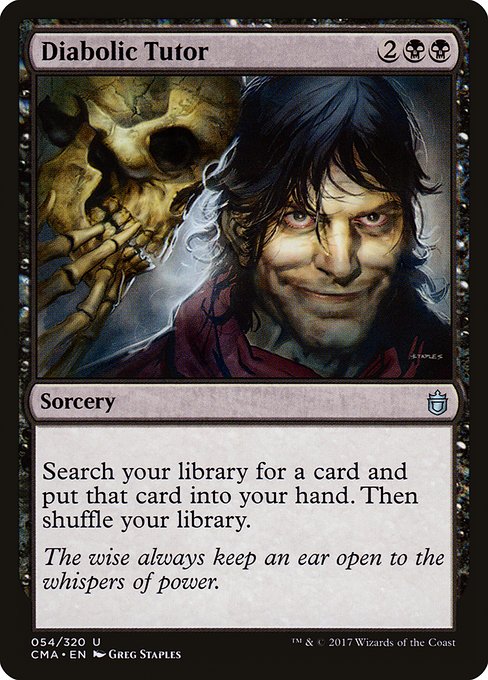 Diabolic Tutor
Search your library for a card, put that card into your hand, then shuffle.
for four mana when
Demonic Tutor
Diabolic Tutor
Search your library for a card, put that card into your hand, then shuffle.
for four mana when
Demonic Tutor
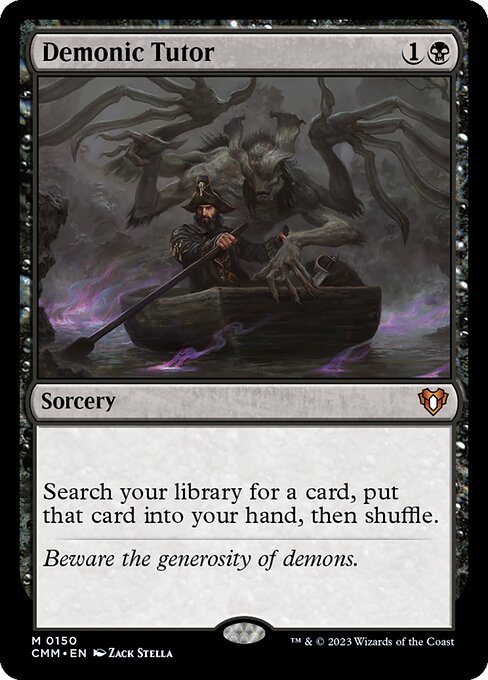 Demonic Tutor
Search your library for a card, put that card into your hand, then shuffle.
does the same thing for only two? Again, it’s not the reward. Both cards are literally word for word identical, they do the exact same thing. What happens when you have a card that does something a bit unique to where there is easy substitute? In that case, however much mana it costs, it might be the lowest mana possible to attain that effect. In that case, it’s a bit less about the risk and a bit more about the reward. This brings me to the card in question, Krark-Clan Ironworks.
Demonic Tutor
Search your library for a card, put that card into your hand, then shuffle.
does the same thing for only two? Again, it’s not the reward. Both cards are literally word for word identical, they do the exact same thing. What happens when you have a card that does something a bit unique to where there is easy substitute? In that case, however much mana it costs, it might be the lowest mana possible to attain that effect. In that case, it’s a bit less about the risk and a bit more about the reward. This brings me to the card in question, Krark-Clan Ironworks.
Is This What a Banned Card Looks Like?

Krark-Clan Ironworks, commonly abbreviated as KCI, proved itself to be too strong for the Modern environment and got a ban. It’s still available in Vintage and Legacy although it’s fallen off in play considerably. However, the saying goes that if a card is banned in one format but available in another, you should give it a consideration. There are Commander decks that utilize KCI, but the card looks like it’s very uncommon at only a one percent population on EDHREC. Compare this card to both
Ashnod’s Altar
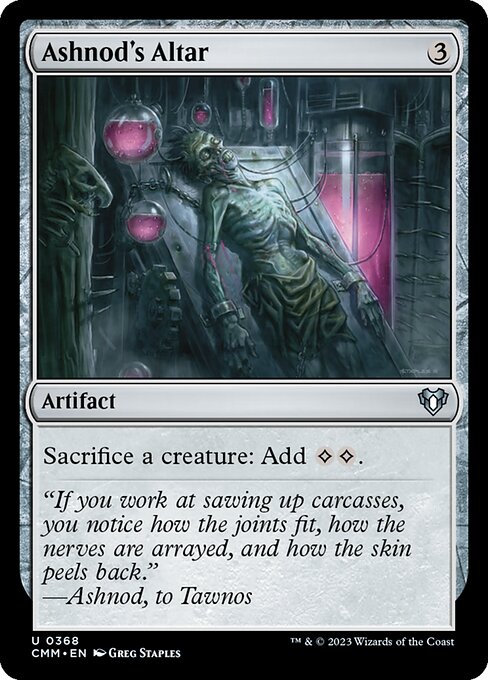 Ashnod’s Altar
Sacrifice a creature: Add {C}{C}.
and
Phyrexian Altar
Ashnod’s Altar
Sacrifice a creature: Add {C}{C}.
and
Phyrexian Altar
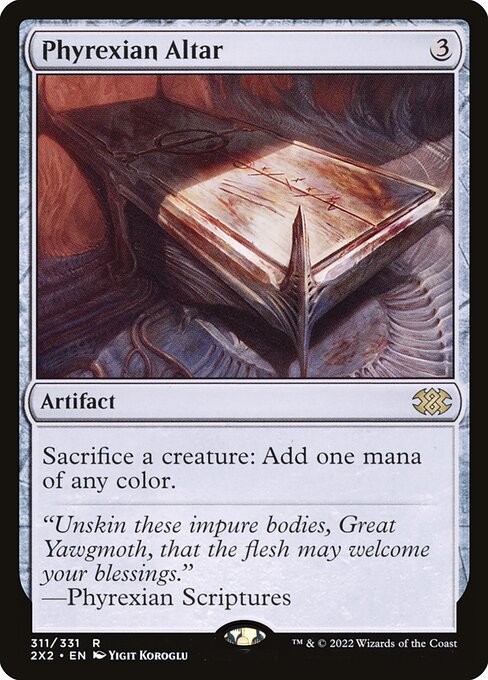 Phyrexian Altar
Sacrifice a creature: Add one mana of any color.
, seeing eight percent and five percent population on EDHREC, and one may wonder why it’s so underplayed? Is four mana versus three mana that big of a difference? However, one percent is still one percent. Here are just a few decks that are currently using KCI.
Phyrexian Altar
Sacrifice a creature: Add one mana of any color.
, seeing eight percent and five percent population on EDHREC, and one may wonder why it’s so underplayed? Is four mana versus three mana that big of a difference? However, one percent is still one percent. Here are just a few decks that are currently using KCI.
Bird is the Word

There is a large number of loops you can generate with Teshar. Here’s a list of 293 of them. KCI, Ashnod’s Altar and Phyrexian Altar are used as sacrifice outlets to power through plenty of different infinite combos. For a deck like Teshar that runs plenty of artifact creatures the difference between the various sac outlets is greatly reduced. Therefore playing the maximum number of copies increases your odds of getting a combo. Still, the commander is only ranked 475. If this idea were completely busted it would rate higher right? That’s not quite right. You see, as a mono white commander, Teshar is 12th in popularity which is pretty good. If we move from white to, say, blue what happens?
Big Bad Blue with Artifacts

A recent cEDH event saw a top eight finish utilizing Urza, Lord High Artificer, a bunch of counterspells, a handful of combo pieces and a massive 42 artifacts. In an artifact heavy deck like this, there’s no wonder why KCI would be included. Furthermore, Urza has a great activated ability that has tremendous synergy with KCI. First, you tap an artifact, then sac it and you get a total of three mana. Therefore, every five artifacts you tap and sac can be turned into three Urza activations and it’s likely you will hit an artifact or two off of those. Depending on what you hit, you can potentially continue activating until you just hit a win.
Clearly the primary win condition is
Sensei’s Divining Top
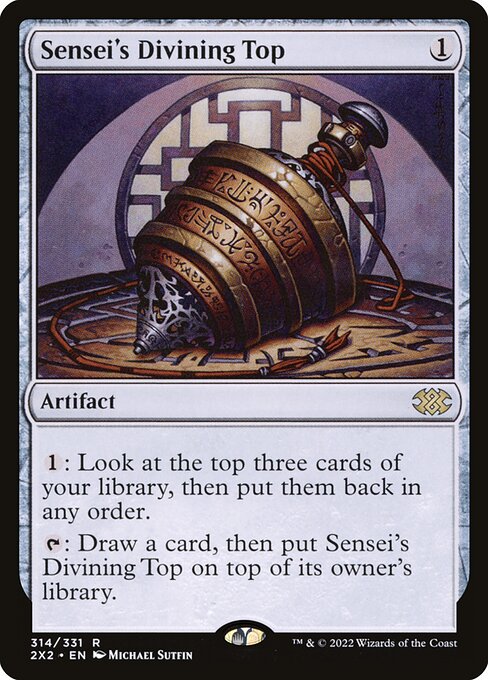 Sensei’s Divining Top
{1}: Look at the top three cards of your library, then put them back in any order.
Sensei’s Divining Top
{1}: Look at the top three cards of your library, then put them back in any order.
{T}: Draw a card, then put this artifact on top of its owner's library.
with
The Reality Chip
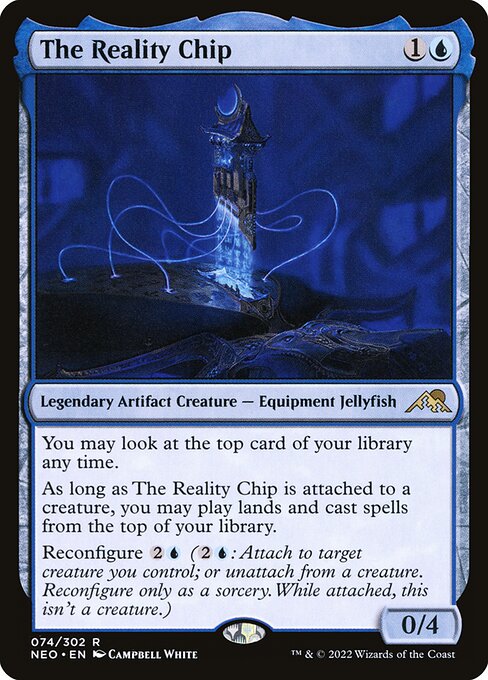 The Reality Chip
You may look at the top card of your library any time.
The Reality Chip
You may look at the top card of your library any time.
As long as The Reality Chip is attached to a creature, you may play lands and cast spells from the top of your library.
Reconfigure {2}{U} ({2}{U}: Attach to target creature you control; or unattach from a creature. Reconfigure only as a sorcery. While attached, this isn't a creature.)
. With Helm of Awakening, you draw your entire deck, play a bunch of stuff for free, gain a ton of life off
Aetherflux Reservoir
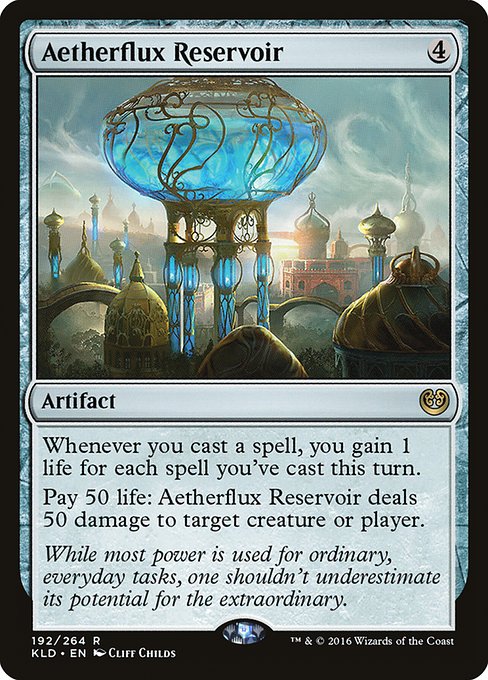 Aetherflux Reservoir
Whenever you cast a spell, you gain 1 life for each spell you've cast this turn.
Aetherflux Reservoir
Whenever you cast a spell, you gain 1 life for each spell you've cast this turn.
Pay 50 life: This artifact deals 50 damage to any target.
and nuke everyone. At any point, KCI turns half of the cards in the deck into enough colorless mana to continue to cast artifacts and activate Urza. Wow, this seems very good here! So good it should be an auto include, right?
So in this case, compared to Teshar, Urza is a top 50 commander with almost 8,000 decks listed but only 399 of them contain KCI. This is very surprising and I wonder if it’s the expense of the card or simply that’s it’s operating just under the radar of many players.
Read More: MTG EDH Spoilers Showcase Multiple Expensive Haymakers!
Four Colors

In terms of absolute number, KCI makes it into thousands of Breya decks even if the percentage is a bit low. The only issue? This is more about
Thopter Foundry
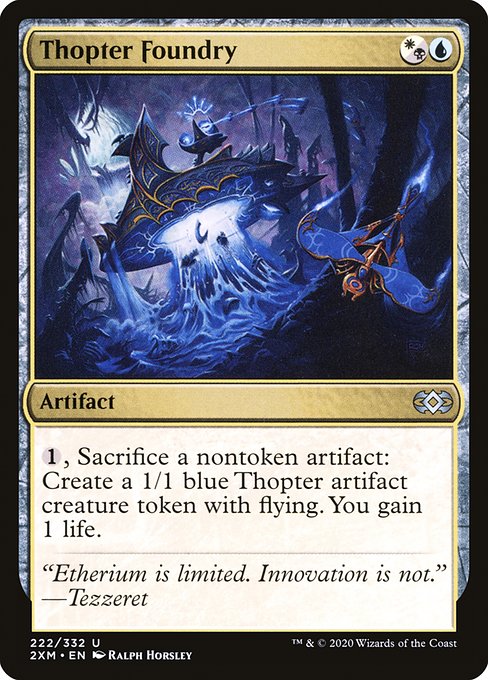 Thopter Foundry
{1}, Sacrifice a nontoken artifact: Create a 1/1 blue Thopter artifact creature token with flying. You gain 1 life.
and Sword of the Meek comboing with KCI for infinite Thopters and infinite mana. With Breya added, that also includes infinite life, -4/-4 triggers and infinite damage to players and Planeswalkers. Why, then, do less than half of the reported Breya decks not include KCI?
Thopter Foundry
{1}, Sacrifice a nontoken artifact: Create a 1/1 blue Thopter artifact creature token with flying. You gain 1 life.
and Sword of the Meek comboing with KCI for infinite Thopters and infinite mana. With Breya added, that also includes infinite life, -4/-4 triggers and infinite damage to players and Planeswalkers. Why, then, do less than half of the reported Breya decks not include KCI?
With so much potential, why does it seem like KCI is seemingly being underplayed? This goes back to the initial idea of risk/reward and the fact that as a four mana “combo piece” it’s simply not that efficient in comparison to other cards. That is the crux of the matter. When compared directly to other enablers like the Altars, costing one more mana is an unforgivable sin. What if, then, the problem is the actual comparison and not the things being compared?
A New Challenger Appears

Maybe most players are looking at the Ironworks wrong. They think the only use for it is as a combo piece. Maybe it’s just an amazing enabler, and the latest thing that LotR is all about is the perfect thing to enable, Food tokens. Pippin and Samwise are all generating second, third, fourth breakfasts and you have several Food tokens lying around. Meriadoc Brandybuck becomes
Magda, Brazen Outlaw
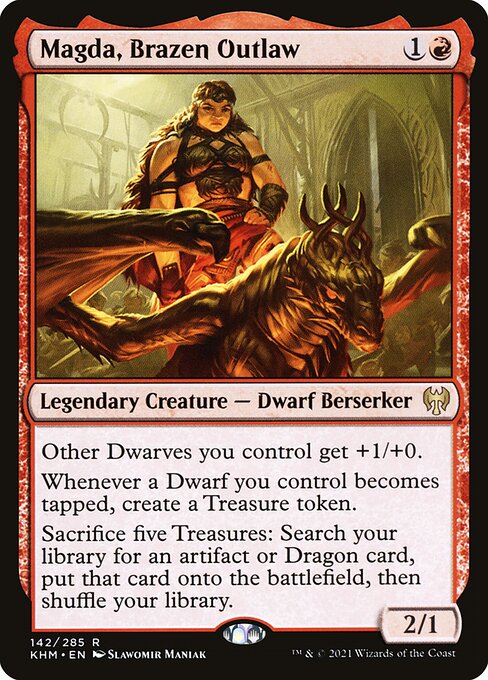 Magda, Brazen Outlaw
Other Dwarves you control get +1/+0.
Magda, Brazen Outlaw
Other Dwarves you control get +1/+0.
Whenever a Dwarf you control becomes tapped, create a Treasure token.
Sacrifice five Treasures: Search your library for an artifact or Dragon card, put that card onto the battlefield, then shuffle.
because your Halflings now attack and generate a two mana token. Speaking of Magda, you can always sacrifice a Treasure to get two colorless instead of one mana of any color and it also works even if the Treasures enter tapped.
KCI becomes mana neutral if you have two Food tokens. How hard is it to generate two Food? Exactly. It’s easy to see how, at five mana,
Doubling Season
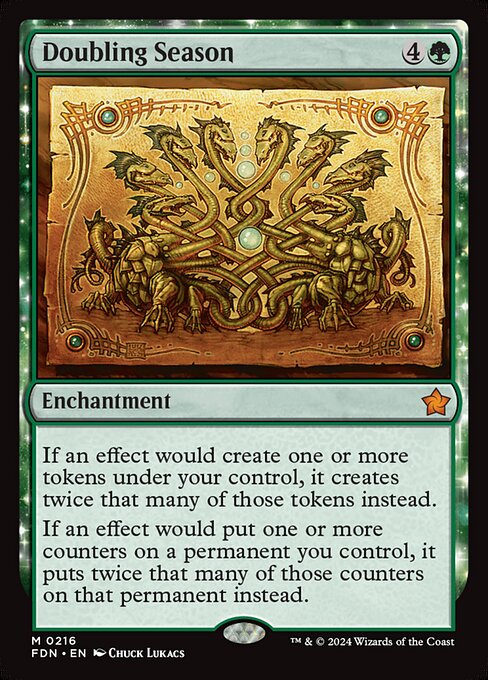 Doubling Season
If an effect would create one or more tokens under your control, it creates twice that many of those tokens instead.
Doubling Season
If an effect would create one or more tokens under your control, it creates twice that many of those tokens instead.
If an effect would put one or more counters on a permanent you control, it puts twice that many of those counters on that permanent instead.
is excellent with Farmer Cotton. But KCI can be nearly as good for four mana instead of five. Say you have four Food and KCI. You sac your Food and get eight mana for Farmer Cotten, so now you’ve doubled your Food. But that eight food can now become 16 mana. Banquet Guests works in a similar fashion and thanks to how Affinity works, you effectively get three mana for each Food used.
When you start to think about Food as a source of two colorless mana, suddenly, many cards go from usable to busted. Gingerbread Cabin is a great land and so is The Shire. Many Partings? Free mana and color fixing. Killer Service? Paying three mana to make six is a rate like
Cabal Ritual
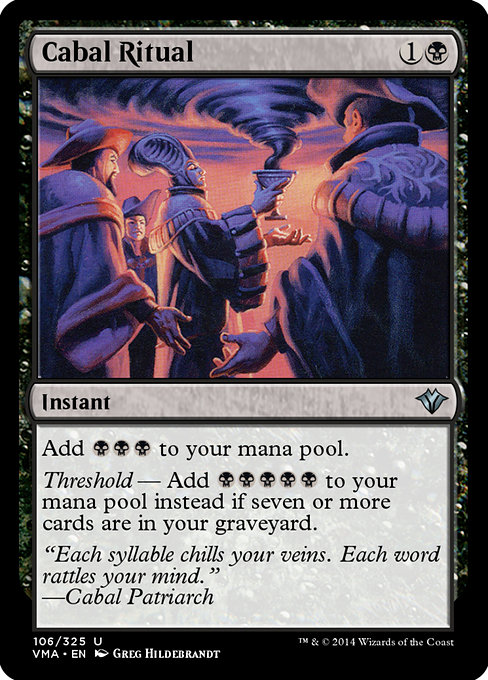 Cabal Ritual
Add {B}{B}{B}.
Cabal Ritual
Add {B}{B}{B}.
Threshold — Add {B}{B}{B}{B}{B} instead if there are seven or more cards in your graveyard.
and
Seething Song
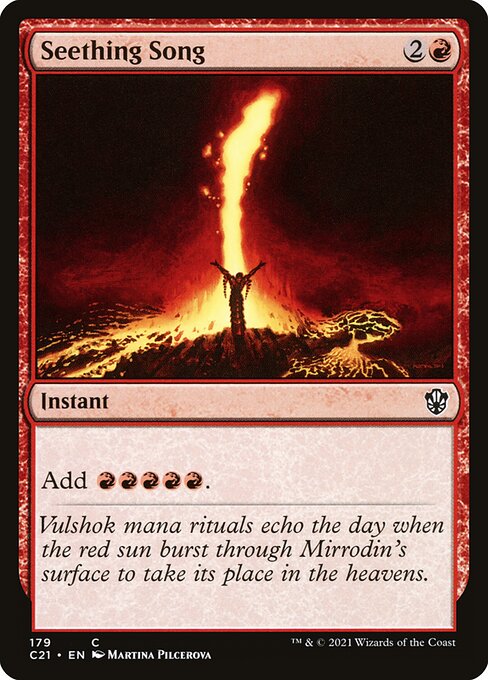 Seething Song
Add {R}{R}{R}{R}{R}.
. So when we look at the comparison between KCI at four mana and Doubling Season at five, you can make a compelling argument that, in many Food based decks, you’re able to gain a substantial advantage one mana sooner. This is noting that with an effect like Doubling Season, it must be in play before you start making Food to gain any advantage off it at all. Ironworks does not care, it’s happy to turn all that old, rotting Food into shiny, new colorless mana to do degenerate things.
Seething Song
Add {R}{R}{R}{R}{R}.
. So when we look at the comparison between KCI at four mana and Doubling Season at five, you can make a compelling argument that, in many Food based decks, you’re able to gain a substantial advantage one mana sooner. This is noting that with an effect like Doubling Season, it must be in play before you start making Food to gain any advantage off it at all. Ironworks does not care, it’s happy to turn all that old, rotting Food into shiny, new colorless mana to do degenerate things.
Read More: Commander’s Best MTG Cycle May Finally Get A Reprint!
Krark and Friends

Sam or Pippin generating a bank of two mana per turn feels really good. Furthermore, having an additional sacrifice outlet that gains you mana is a great thing to have with Mirkwood Bats. Frodo’s purpose is to draw you into a tutor. Suddenly, the entire deck makes that much more sense.
Having a pile of Food tokens is a resource that does not only represent life, it can be absolutely ludicrous amounts of mana that you can start generating as soon as turn one. It’s not hard to imagine having four or five Food ready and waiting to cast a huge X mana spell like Genesis Wave to dump even more permanents onto the battlefield, like generating a ton of Food so that you can do it all over again next turn. This version of the deck could also play cards like Clock of Omens to turn every two Food into an untap on a mana rock. Turning Food into life does not do very much, turning it into a little card draw is alright, but turning it into mana makes the deck have legs.
KCI Coming to a Deck Near You?
Maybe. I think the card is significantly better than a one percenter. Almost any card can appear to be exceptional in a narrow deck and KCI absolutely belongs in decks like Teshar and Urza. However, all of the new Food generation effects in LotR absolutely combo amplify the card. Turning Food into yet another resource makes it that much better.
Generating Food is very easy, zero risk, but it carries very little reward. In that case, the perfect type of card to compliment that mechanic is one with a ban-worthy payoff that might just be a little bit too risky at four mana. Additional combo cards like Saffi Eriksdotter and Renegade Rallier are in the colors if you want to go with another Altar with artifact creatures and KCI route. The simple fact is, if it’s too good for Modern, it’s likely you should be trying it in more of your Commander decks!
Read More: MTG Players Outraged by $400+ Commander Masters Boxes