

Getting into MTG as a new player can be intimidating. Not only is the game very difficult to learn, but there are tens of thousands of cards you may need to memorize.
If that weren’t enough, MTG can easily get quite expensive, too, especially if new players decide to jump into 60-card formats. Fortunately, a more beginner-friendly option is available for one-on-one Magic: Draft.
Beyond helping you build your collection, Draft is one of the best ways to learn how to play MTG. The barrier to entry is low, but the high ceiling also makes Draft one of the hardest formats to master.
Don’t worry! Learning Draft may seem overwhelming at the beginning, but we’re here to help. After years of playing Draft and even qualifying for Arena Championship 11 through Sealed, these are the tips I wish I’d had as an MTG player trying Draft for the first time.
How to Play Draft
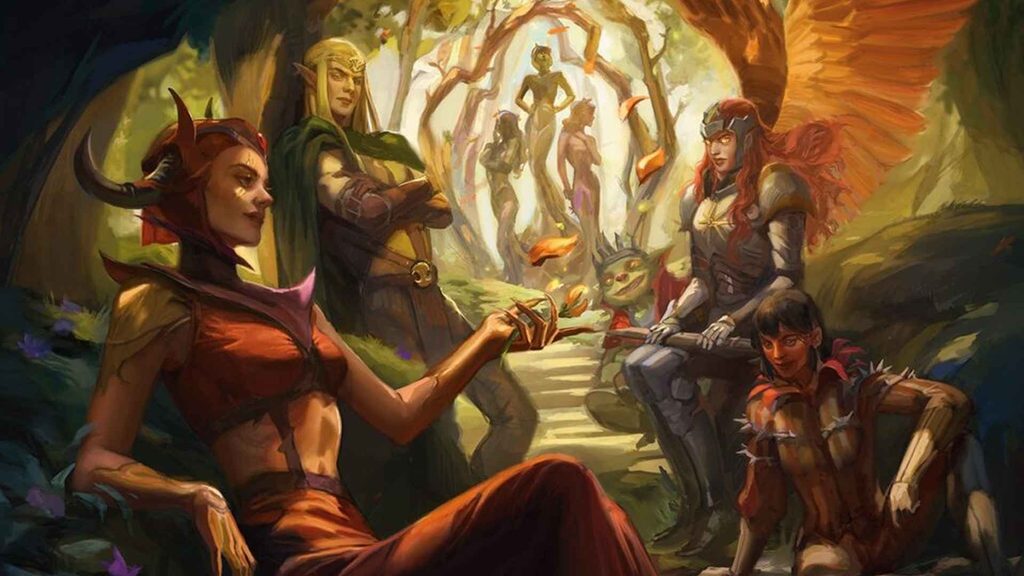
If you’re just starting MTG Draft, you may not even know the rules yet. Here, I’ll explain how to play Draft and the difference between Draft and Sealed. If you already know the rules and are here for some tips, feel free to skip this section.
Draft typically involves eight players, each with three booster packs to open. To start a draft, each player opens a booster pack of cards and removes the token from the pack. Then, you’ll pick one card from the pack to play with and pass the rest of your pack to the left. Keep passing booster packs around the table until there are no cards left to pick from.
Once that’s done, you’ll open your second booster pack. This time, pass your cards to the right instead of the left. Then, for the final booster pack, pass cards to the left again. It can be easy to mess up the directions, but I find remembering to start clockwise is a good way to think about it.
Your objective is, basically, to assemble the best 40-card deck at the table using the cards you find in these packs. Notably, basic lands are provided to you outside of these packs, so don’t worry about grabbing those in your packs.
If you’re playing Draft with four players, the rules are pretty much the same, but you’ll take two cards from each pack instead of one. It’s not uncommon for local game stores to draft with numbers other than eight or four depending on how many players show up, but eight is typically the number of players needed to host a proper MTG Draft.
Sealed is the format that you play during Prerelease events, and is a bit different from Draft. Instead of passing booster packs around to other players, you’ll get six booster packs to open and keep for yourself. You need to build a 40-card deck out of these cards, which can be incredibly challenging depending on what you open. Once again, you have an unlimited number of basic lands you can use from outside of your packs.
So, learning how to play Draft and Sealed isn’t that hard, but playing them well is quite difficult. After we cover the supplies you’ll want as a new drafter, you’ll find plenty of tips to get you started on the right foot.
The Supplies
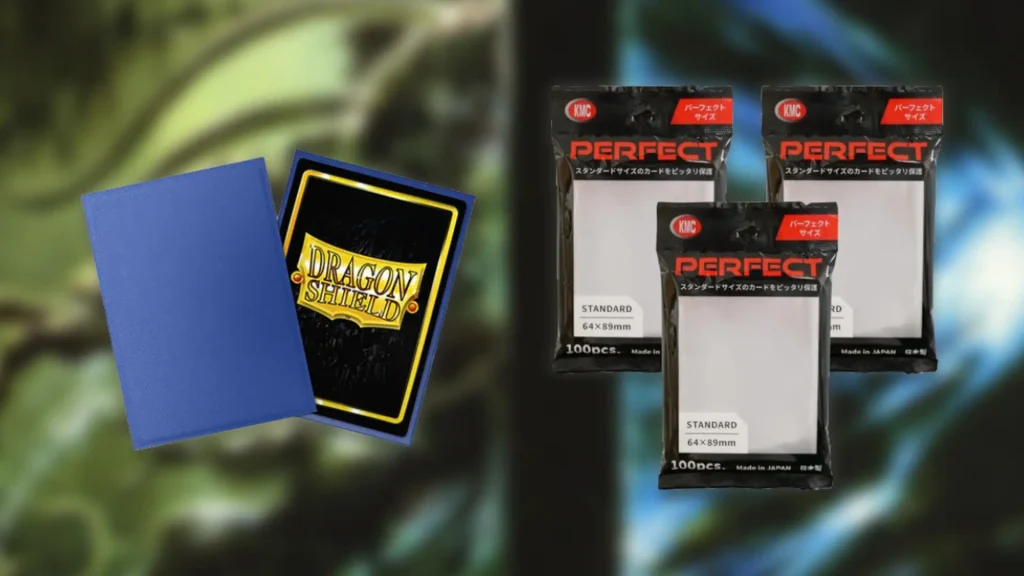
You can skip this section if you’re just playing digital drafts on MTG Arena or MTGO, but if you want to open some boosties at your local game store, here are a few things I’d bring to your first draft for the best experience.
The biggest thing is sleeves, not only to protect your cards but also to make them easier to shuffle. More often than not, your draft deck won’t be worth much, but there’s always the chance you’ll open a hit in one of your draft packs. If you do, you’ll want sleeves to keep that card in good condition.
On top of that, many MTG sets now include double-sided cards, which makes sleeves mandatory. Otherwise, you’ll have marked cards in your deck since you can tell what they are when they’re face-down. Long story short, it’s extremely ill-advised to play MTG without sleeves.
If you need guidance on which sleeves to buy, we cover that in our sleeves guide.
Other than sleeves, the only thing I’d strongly recommend for playing Draft is pen and paper to track life totals. You can do this with dice or a phone, which is fine in a casual setting, but pen and paper are more reliable options.
If someone knocks your life dice over, or your phone runs out of battery, you’ll realize how easy it is to forget something as crucial as life totals. Keeping a pen-and-paper record of both players’ life totals helps reduce accidents like this and leads to a smoother gameplay experience.
As a side note, if you’re interested in trying your hand at Draft competitively, keeping track of life totals with pen and paper is mandatory.
These are really the only things you absolutely need for Draft, in my opinion, aside from the booster packs, of course. That said, there are a few more things you may want to have to maximize your experience.
While local game stores should have a land station to supply basic lands, you can also bring your own. This is a fun option if you have a set of basic lands you really enjoy playing with, like full-art lands, but it can also speed up your deckbuilding.
At first, it’s common to spend a lot of time figuring out the exact cards you want in your deck, and having your own lands can give you more time to think, especially if they’re pre-sleeved. If you’re playing the same Draft format a lot, it’s also not a bad idea to keep a collection of commonly used tokens, which makes board states easier to understand.
The only other thing to mention is a deck box, which you can also use to store your pre-sleeved lands and tokens. Just be sure to keep the lands you aren’t using separate from the cards you’re playing.
Also, as a final aside, do not use foil lands as your pre-sleeved lands of choice. Unfortunately, these lands can warp very easily, making them marked cards.
The Basics

One of the most common mistakes that I see new players make is stuffing too many cards into their draft decks. I get it; there are so many exciting cards to play with, and you want to use them all!
In reality, you want to keep your deck as streamlined as possible to maximize your chances of seeing your best cards. Speaking of consistency, there’s generally a golden ratio that most drafters use to improve this.
Typically, your Draft and Sealed decks should include 23 nonland cards and 17 lands, a ratio widely considered the best in the MTG community. This minimizes your chances of getting mana screwed or flooded, which is easily the most frustrating aspect of playing MTG in general.
You can tinker with this a bit, going to 16 lands if you’re playing a lot of cheap cards, but to start, just sticking with 23 nonlands and 17 lands is safe.
Breaking this down further, you’ll typically want about 7 noncreature spells in your deck, but that can vary heavily depending on the Draft format and the archetype you’re playing. If you’re playing an Izzet Spellslinger deck, for example, you’ll probably want a lot more noncreature cards.
Most of the time, the best draft decks involve two colors, but that varies quite a bit depending on the set you’re playing. Limiting yourself to one color can make it hard to find 23 decent cards during the draft, and adding more colors can make it hard to cast your spells.
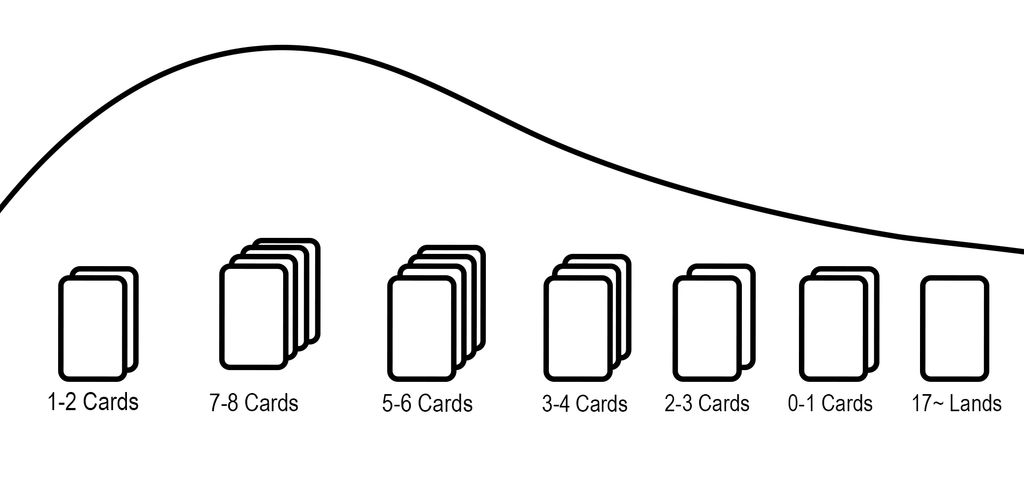
The mana value of the nonland cards you include is important, too, with the right ratio of cards at each cost smoothing out your play experience. Above is the recommended mana curve from Wizards of the Coast themselves, and will lead to decks that can play pretty well in the beginning. This basically breaks down as the following:
- 1 Mana: 1–2 cards
- 2 Mana: 7–8 cards
- 3 Mana: 5–6 cards
- 4 Mana: 3–4 cards
- 5 Mana: 2–3 cards
- 6+ Mana: 0–1 card
- and 17 lands
Do note, however, that this concept can vary heavily depending on the format you’re playing, as well as the archetype. Slower decks may want more 6+ mana cards to win the game, while faster decks will want more things at one mana. This is just a safe blueprint to use while you’re learning the game.
It’s not uncommon to splash a third color for more powerful cards, and many MTG sets provide mana fixing to support this. Look out for dual-colored lands, cards that tap for any color of mana, or cards that can otherwise find basic lands if you’re planning on doing this.
Generally, it’s best practice to splash higher-costed bombs in Limited, if you splash anything. Not only will your splashed cards be more impactful, but you’ll have more time to find your scarce color.
If you do plan on splashing a third color, common practice is to have at least three sources of that color in your mana base, more if you’re splashing multiple cards. Splashing refers to including just a few cards of a color instead of making a significant portion of your deck focused on it.
To get the hang of this concept, simply watching one of the many talented Limited streamers can point you in the right direction. I’ve lost plenty of games to streamers like Numot the Nummy and Paul Cheon, as have many others, and watching them can seriously upgrade your Draft game.
Learning the Format

While the rules for Draft and Sealed generally remain the same across MTG sets, how those sets play can vary a lot. Different sets support different color combinations, with some sets focusing on three-color combos and others supporting mono-color.
Fortunately, learning what color combinations perform best is pretty easy nowadays. 17Lands.com offers individual win rates for draft cards in all the more recent MTG sets. This should help highlight which colors perform best and what cards you really don’t want to pass.
As for which color combinations to try, 17Lands does have data for that too, but Wizards of the Coast will generally tell you which color combos are supported most of the time. It’s quite common for Wizards to put up a Draft article for each prerelease, which can do a great job of helping point you in the right direction.
It’s important not to take this data as gospel and to draw your own conclusions, but for new players, following 17Lands’ data can give you a strong grounding in any given Draft format.
Basic Drafting Tips

Moving on to more generic information, removal is very important when drafting your deck. Remember the 7 noncreature spell number I mentioned earlier? Ideally, you want all of that to be removal if possible. Of course, you can sometimes get removal attached to a creature (which generally makes for a very powerful card), and you may want room for card draw depending on how slow your deck is, but prioritizing removal is key.
Otherwise, all your opponent needs to do is play a bomb or a synergistic value engine, and you’ll often lose.
I also find that when drafting, it’s best to keep your options open in the early picks. Instead of picking a bunch of strong cards across colors, try to stick with one color as much as possible.
This will not only cut off the color for the player to your left, making it more likely you get good cards in that color later, but it will also let you pick up strong cards across colors later in the draft.
That leads to the most important aspect of drafting: figuring out what’s open. What cards are good in a draft is something that most people will know, so some colors might see more demand at a table than others. If the players beside you are in the same colors as you, they’ll take most of the good cards you could play.
Figuring out what’s open is the tough bit, but more often than not, it’s about identifying cards that are going late in packs. This means a strong card is going later in a pack than it generally would, suggesting fewer players are in that color, or the archetype that wants that card. Less competition means you can pick up better cards more often.
Just knowing what the good cards are by using 17Lands can help identify this.
This is a personal choice, but because I like drafting decks with higher color counts, I also tend to draft fixing quite highly, especially in slower formats. This can help unlock more powerful cards later, but in faster formats, it’s generally not a strong idea.
Advanced Tips

If you’re lining up to play your first Draft, don’t sweat these tips too much, as they aren’t super necessary at the beginning, but can really help you out once you get the hang of things. These are the tips I would have wanted as a new player, so I want to share these with you, too.
A big one for me is learning what all the common instant-speed removal and interaction is in a particular Draft format. If you can figure out a list of commons and uncommons to play around, you can often get out of your opponent’s traps by seeing a step ahead.
For example, if your opponent is holding up four black and blue mana in MTG Star Trek, there are quite a few different things that they could have. Between He’s Dead, Jim He’s Dead, JimDestroy target creature. Surveil 1. (Look at the top card of your library. You may put it into your graveyard.), Consider the Prime Directive
 Consider the Prime DirectiveChoose one —
• Interfere — Counter target spell unless its controller pays {3}.
• Observe — Tap up to one target creature and put a stun counter on it. Draw a card. (If a permanent with a stun counter would become untapped, remove one from it instead.), and Guidance Failure Guidance FailureThis spell costs {1} less to cast if it targets an attacking creature.
Target creature or Spacecraft's owner puts it on their choice of the top or bottom of their library., there are a lot of different interactions you could face, and they all care about different things. Highly Illogical Highly IllogicalKicker {1}{U} (You may pay an additional {1}{U} as you cast this spell.)
Counter target spell with mana value 2 or less. If this spell was kicked, instead counter target spell. may also be possible, but since that’s uncommon, it’s a bit less likely. It’s also a possibility that your opponent has nothing at all.
In this case, however, the vast majority of the interaction cares about creatures, while Consider the Prime Directive can be played around with enough mana. Not playing a creature into this mana, or holding up enough mana to pay for the three mana to Prime Directive, for example, can make your opponent’s mana really awkward to use.
Frankly, this idea deserves a much more detailed explanation, and those explanations are available around the internet, but this should at least put the idea in your head and lead you to discover more.
Another big tip I’ve heard from a lot of really good Draft players is not to get lost in shiny card syndrome. Many players focus on playing the best bombs that they drafted, or opened in their Sealed pack. What’s more important, however, is actually the worst card you’re playing.
If the best bomb in your Sealed pool, or an off-color card in your Draft, forces you to play a ton of bad cards to use it, your deck will likely be worse overall than not playing the card.
This idea is especially important in Sealed, where it’s easy to get lost in shiny card syndrome. It varies by set, but in my experience, prioritizing a strong, cohesive game plan is often more effective than playing a bunch of ok cards with a few big bombs.
By focusing on the worst card in your deck, you’re basically making all your cards as impactful as possible. It makes luck a bit less of a factor when the vast majority of your deck is sturdy, instead of praying to see a few specific cards.
Finally, if you’re going to a competitive Limited event, I’d argue that learning how to play the format’s bad archetypes is even more important than knowing how to draft the good ones. At competitive tables, chances are most, if not all, of the MTG players there know which cards are good and bad and will try to get into the stronger colors.
This means you may often end up in bad archetypes because the good ones are getting cut by the players beside you. Since there’s a strong chance that you’ll end up in these archetypes, knowing what to do, or what cards to pick over others, is extremely important. Often, when the entire Draft table knows the best cards, weaker archetypes shine because they face much less competition.
Hopefully, these Draft tips will help start your journey into MTG’s Limited formats. As one of the best ways to learn the game and build your collection at the same time, Draft is an incredible tool for new players.
There’s a ton more to learn, too, so if you enjoy jumping into Draft, take a gander at all the extremely talented MTG streamers in the fanbase. We also write first-impression guides for each new set thanks to MTG Arena’s generosity in granting us Early Access, which can help you go into new prereleases with a plan.
Stick with us here at mtgrocks.com: the best site for Magic: The Gathering coverage. Be sure to check out our deckbuilder for your next big brew, and our brand new MTG Rocks Podcast! MTGRocks’ editorial and corrections policy lets us create content you can trust.