


At this point, it’s no surprise just how impactful Outlaws of Thunder Junction has been in various Constructed formats.
Kaervek, the Punisher
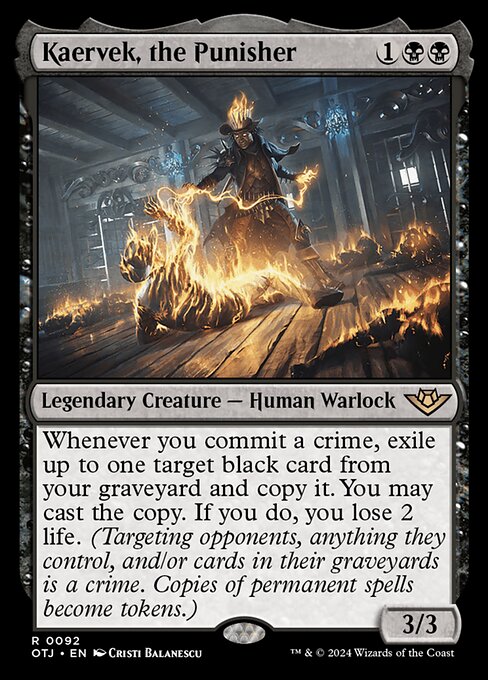 Kaervek, the Punisher
Whenever you commit a crime, exile up to one target black card from your graveyard and copy it. You may cast the copy. If you do, you lose 2 life. (Targeting opponents, anything they control, and/or cards in their graveyards is a crime. Copies of permanent spells become tokens.)
and
Pillage the Bog
Kaervek, the Punisher
Whenever you commit a crime, exile up to one target black card from your graveyard and copy it. You may cast the copy. If you do, you lose 2 life. (Targeting opponents, anything they control, and/or cards in their graveyards is a crime. Copies of permanent spells become tokens.)
and
Pillage the Bog
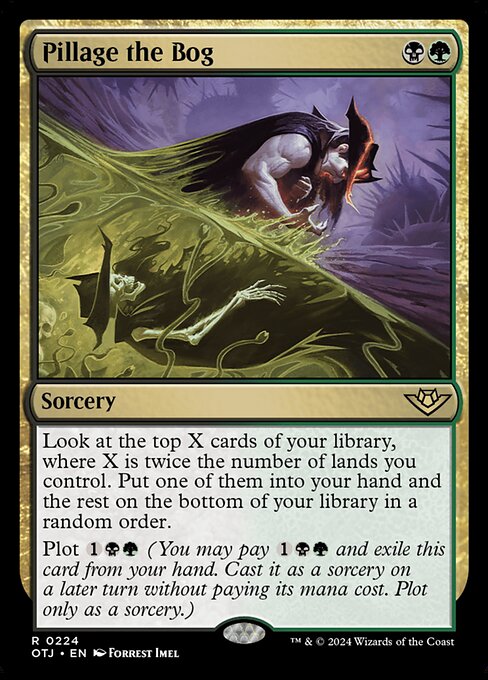 Pillage the Bog
Look at the top X cards of your library, where X is twice the number of lands you control. Put one of them into your hand and the rest on the bottom of your library in a random order.
Pillage the Bog
Look at the top X cards of your library, where X is twice the number of lands you control. Put one of them into your hand and the rest on the bottom of your library in a random order.
Plot {1}{B}{G} (You may pay {1}{B}{G} and exile this card from your hand. Cast it as a sorcery on a later turn without paying its mana cost. Plot only as a sorcery.)
have proven themselves as elite upgrades in Pioneer. In Modern,
Slickshot Show-Off
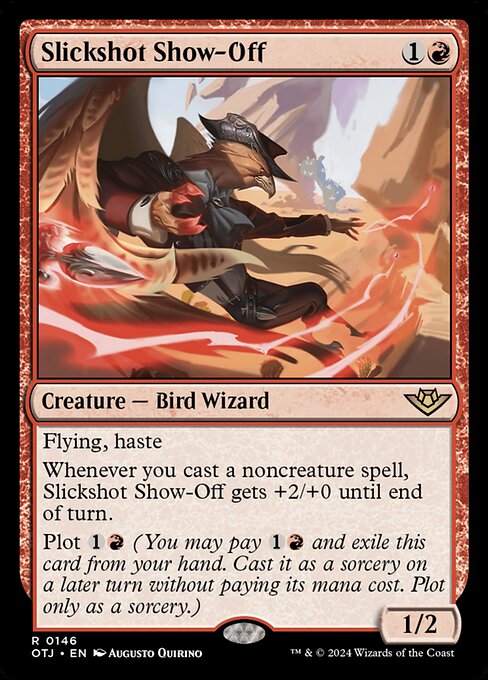 Slickshot Show-Off
Flying, haste
Slickshot Show-Off
Flying, haste
Whenever you cast a noncreature spell, this creature gets +2/+0 until end of turn.
Plot {1}{R} (You may pay {1}{R} and exile this card from your hand. Cast it as a sorcery on a later turn without paying its mana cost. Plot only as a sorcery.)
has elevated Prowess decks to a new level. Meanwhile,
Simulacrum Synthesizer
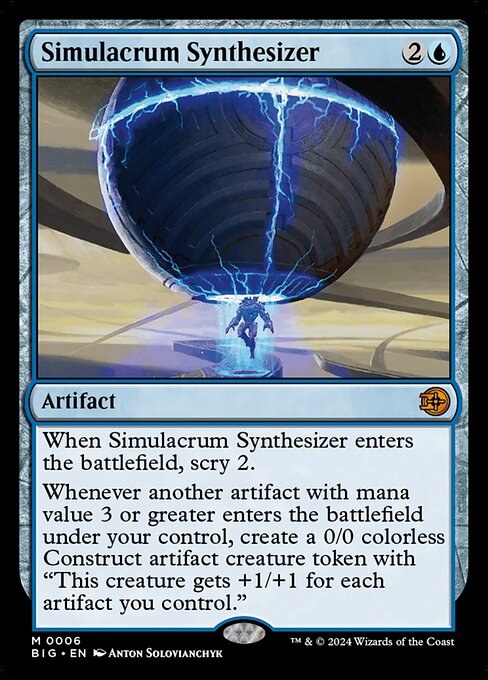 Simulacrum Synthesizer
When this artifact enters, scry 2.
Simulacrum Synthesizer
When this artifact enters, scry 2.
Whenever another artifact you control with mana value 3 or greater enters, create a 0/0 colorless Construct artifact creature token with "This token gets +1/+1 for each artifact you control."
has been crushing tournaments in Legacy Artifacts shells.
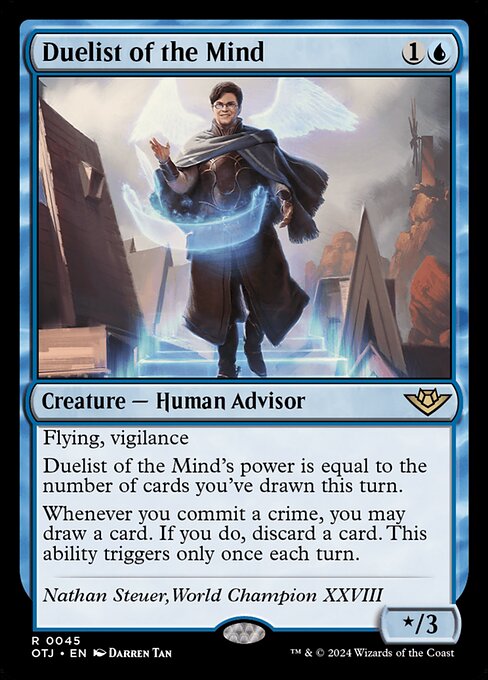
Interestingly, though, the format that Thunder Junction has arguably had the least effect on is Standard. Despite having the smallest card pool by far, the vast majority of top-tier archetypes look nearly identical to how they did before Thunder Junction arrived. Domain strategies are still as dominant as ever. While some Esper midrange decks have incorporated
Duelist of the Mind
 Duelist of the Mind
Flying, vigilance
Duelist of the Mind
Flying, vigilance
Duelist of the Mind's power is equal to the number of cards you've drawn this turn.
Whenever you commit a crime, you may draw a card. If you do, discard a card. This ability triggers only once each turn.
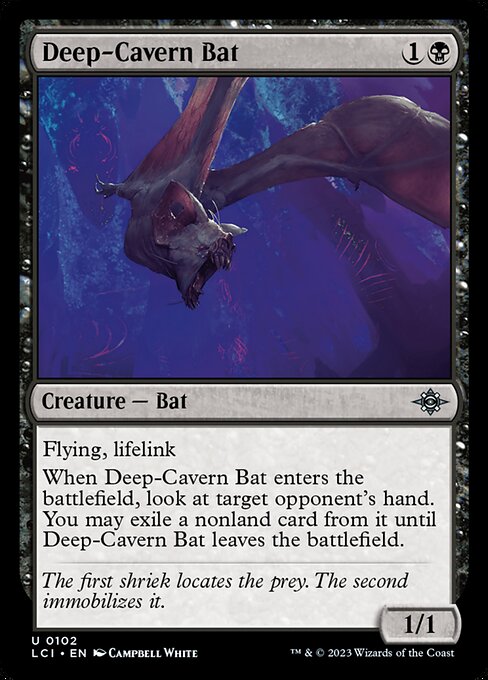
, the main base for the deck still revolves around the power of
Deep-Cavern Bat
 Deep-Cavern Bat
Flying, lifelink
Deep-Cavern Bat
Flying, lifelink
When this creature enters, look at target opponent's hand. You may exile a nonland card from it until this creature leaves the battlefield.
and
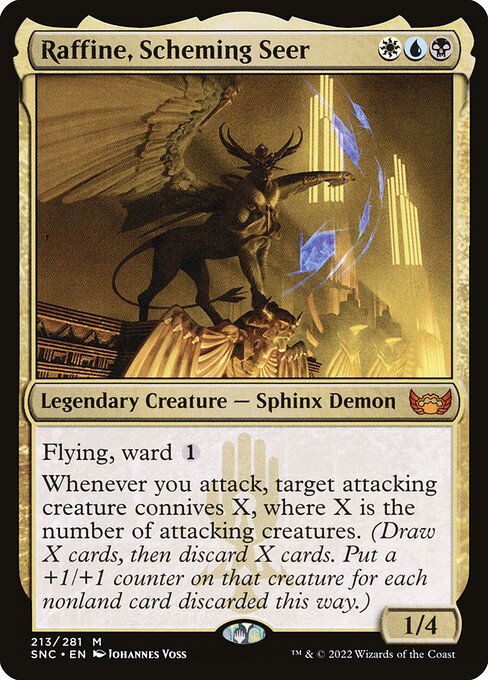
Raffine, Scheming Seer
 Raffine, Scheming Seer
Flying, ward {1}
Raffine, Scheming Seer
Flying, ward {1}
Whenever you attack, target attacking creature connives X, where X is the number of attacking creatures. (Draw X cards, then discard X cards. Put a +1/+1 counter on that creature for each nonland card discarded this way.)
.
For players hoping for a major shakeup with the introduction of Thunder Junction, you may be out of luck. As it turns out, the solution to mixing up Standard may not come just by adding one set at a time. Standard is set to rotate in August 2024, with four sets leaving Standard forever.
Innistrad: Midnight Hunt, Innistrad: Crimson Vow, Kamigawa: Neon Dynasty, and Streets of New Capenna will all be gone, and players are already discussing what cards they are most excited to see leave Standard. Some of these sets have been at the forefront of Standard for a while, so perhaps this rotation will provide the jolt that the format needs.
Domain Pain
In a recent discussion forum, players were talking about the cards they are most looking forward to rotating out of Standard. Obviously, this question is rather subjective, and there were a lot of different responses given. Still, there were plenty of cards and archetypes that garnered a great deal of attention. Many cards that players mentioned all came in one deck: Domain ramp.
This is not shocking in the least, for multiple reasons. First, this deck has been extremely strong for over a year. With a few exceptions like
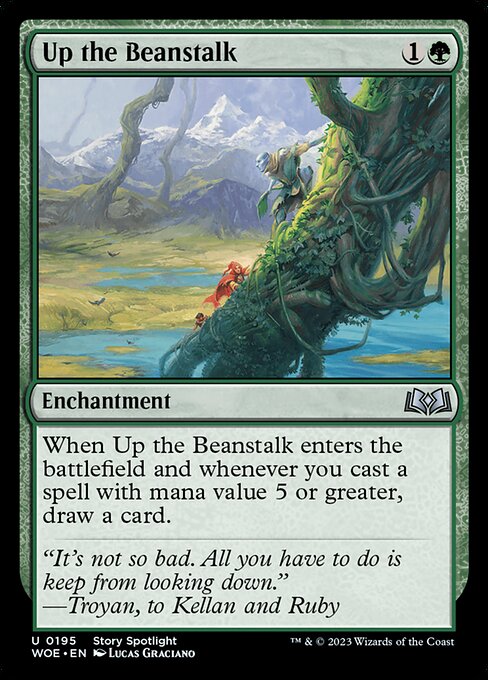
Up the Beanstalk
 Up the Beanstalk
When this enchantment enters and whenever you cast a spell with mana value 5 or greater, draw a card.
and
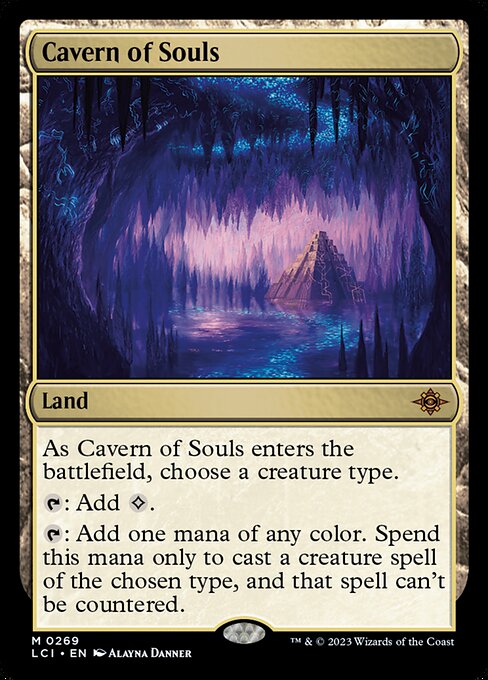
Cavern of Souls
Up the Beanstalk
When this enchantment enters and whenever you cast a spell with mana value 5 or greater, draw a card.
and
Cavern of Souls
 Cavern of Souls
As this land enters, choose a creature type.
Cavern of Souls
As this land enters, choose a creature type.
{T}: Add {C}.
{T}: Add one mana of any color. Spend this mana only to cast a creature spell of the chosen type, and that spell can't be countered.
, nearly every card featured in the deck was printed over a year ago. As such, this strategy has remained a tier one archetype nearly that whole span.
Multiple different top-end cards from the deck, including
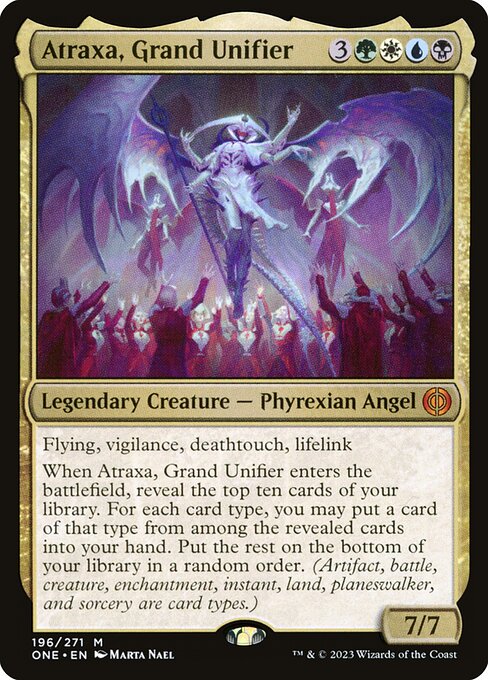
Atraxa, Grand Unifier
 Atraxa, Grand Unifier
Flying, vigilance, deathtouch, lifelink
Atraxa, Grand Unifier
Flying, vigilance, deathtouch, lifelink
When Atraxa enters, reveal the top ten cards of your library. For each card type, you may put a card of that type from among the revealed cards into your hand. Put the rest on the bottom of your library in a random order. (Artifact, battle, creature, enchantment, instant, land, planeswalker, and sorcery are card types.)
and of course,
Sunfall
 Sunfall
Exile all creatures. Incubate X, where X is the number of creatures exiled this way. (Create an Incubator token with X +1/+1 counters on it and "{2}: Transform this token." It transforms into a 0/0 Phyrexian artifact creature.)
, were brought up as being a bit format-warping. This is yet another reason the Domain deck is so despised. After all, a resolved Atraxa spells game over for most decks in the format, and Creature decks often can’t come back from Sunfall. As a result, players have been forced to lower their curves significantly or risk getting completely outclassed.
Sunfall
Exile all creatures. Incubate X, where X is the number of creatures exiled this way. (Create an Incubator token with X +1/+1 counters on it and "{2}: Transform this token." It transforms into a 0/0 Phyrexian artifact creature.)
, were brought up as being a bit format-warping. This is yet another reason the Domain deck is so despised. After all, a resolved Atraxa spells game over for most decks in the format, and Creature decks often can’t come back from Sunfall. As a result, players have been forced to lower their curves significantly or risk getting completely outclassed.
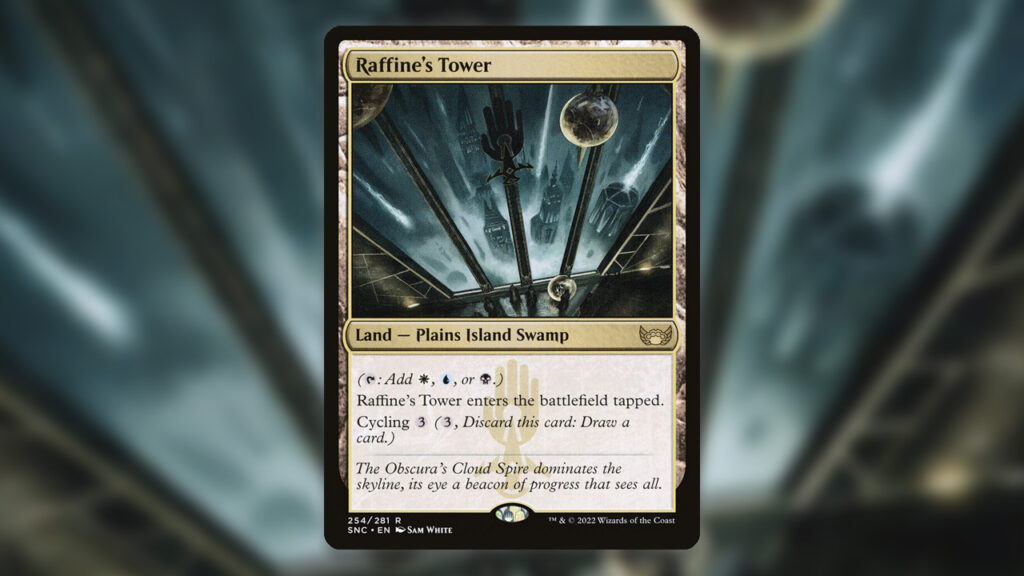
Unfortunately, neither of these cards are leaving Standard in August. However, they will have to find new homes, as Domain as we know it should cease to exist. The fact of the matter is, the new “Triomes” like Spara’s Headquarters, Raffine’s Tower, and beyond acted as the cornerstone of this shell. Without them, it becomes incredibly difficult to maximize all of the multi-color payoffs, including Atraxa and
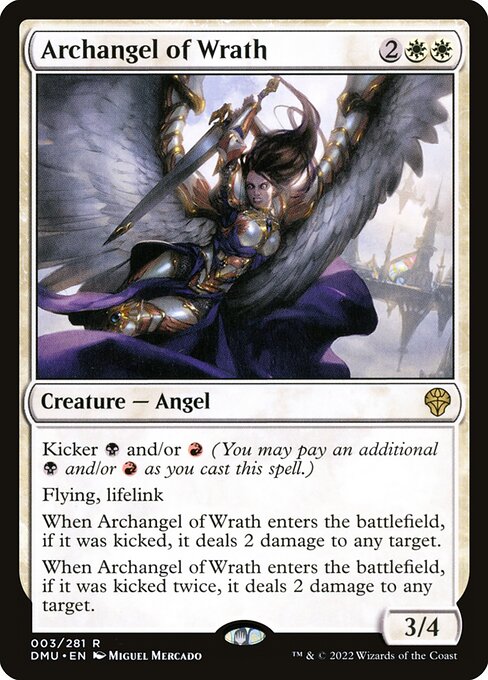
Archangel of Wrath
 Archangel of Wrath
Kicker {B} and/or {R} (You may pay an additional {B} and/or {R} as you cast this spell.)
Archangel of Wrath
Kicker {B} and/or {R} (You may pay an additional {B} and/or {R} as you cast this spell.)
Flying, lifelink
When this creature enters, if it was kicked, it deals 2 damage to any target.
When this creature enters, if it was kicked twice, it deals 2 damage to any target.
, this deck plays.
Beyond that, this deck is incredibly reliant on
Leyline Binding
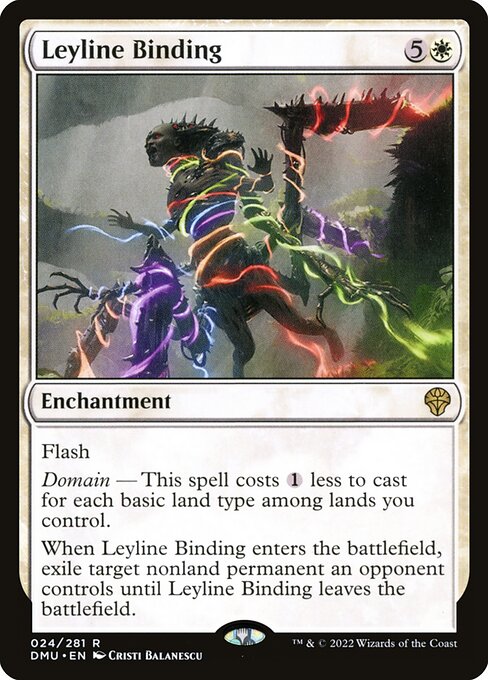 Leyline Binding
Flash
Leyline Binding
Flash
Domain — This spell costs {1} less to cast for each basic land type among lands you control.
When this enchantment enters, exile target nonland permanent an opponent controls until this enchantment leaves the battlefield.
as an early piece of cheap interaction. Leyline Binding doesn’t rotate out of Standard either but becomes much worse without these Streets of New Capenna Lands with three Land types. If you’re as sick of this deck as I am, Standard’s rotation may be just what you need to get excited about the format once more.
Read More: MTG Arena Players ”Scammed” by Bizarre Cosmetic Quirk
Not the Only Lands to Bite the Dust

Astonishingly, the group of Lands mentioned above aren’t the only cycle from Streets of New Capenna wreaking havoc on Standard. Since the release of Murders at Karlov Manor, a collection of Lands that gain life and sacrifice themselves when they enter the battlefield, such as Brokers Hideout, have helped give rise to a new strategy. Temur ramp in its current form revolves entirely around these Lands.
Both
Aftermath Analyst
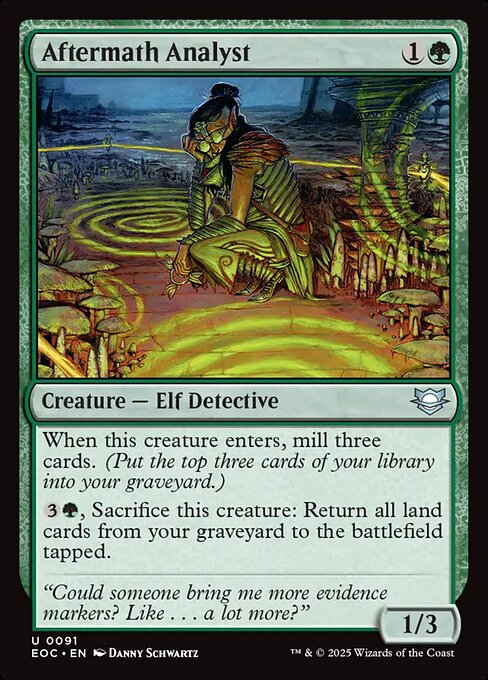 Aftermath Analyst
When this creature enters, mill three cards. (Put the top three cards of your library into your graveyard.)
Aftermath Analyst
When this creature enters, mill three cards. (Put the top three cards of your library into your graveyard.)
{3}{G}, Sacrifice this creature: Return all land cards from your graveyard to the battlefield tapped.
and
Worldsoul’s Rage
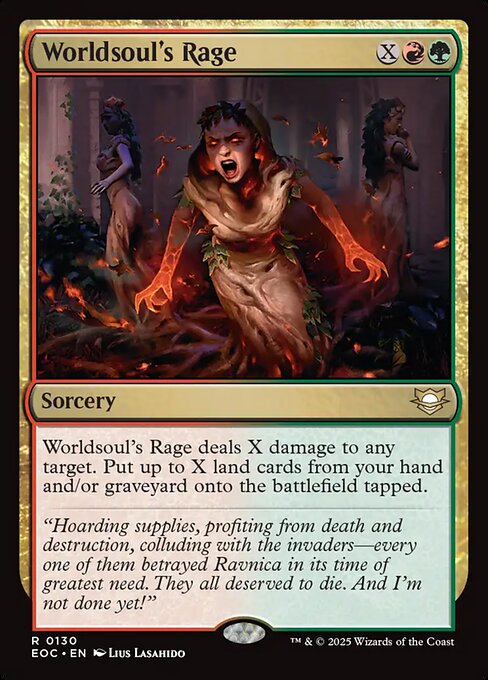 Worldsoul’s Rage
Worldsoul's Rage deals X damage to any target. Put up to X land cards from your hand and/or graveyard onto the battlefield tapped.
act as elite ramp enablers in conjunction with these Lands. You simply spend the first few turns playing these Lands and developing your mana, then bring them all back. The life gain cushion makes it quite difficult to race, and the mana advantage you gain makes it tough to go over the top of.
Worldsoul’s Rage
Worldsoul's Rage deals X damage to any target. Put up to X land cards from your hand and/or graveyard onto the battlefield tapped.
act as elite ramp enablers in conjunction with these Lands. You simply spend the first few turns playing these Lands and developing your mana, then bring them all back. The life gain cushion makes it quite difficult to race, and the mana advantage you gain makes it tough to go over the top of.
Worldsoul’s Rage’s ability to act as a removal spell/burst of ramp in the early game and a Fireball to win the game with in the late game has brought specific attention to it. Once again, though, Worldsoul’s Rage isn’t going anywhere in August. Luckily, with the Streets of New Capenna Lands rotating, this deck’s entire gimmick goes out the window.
Aftermath Analyst and Worldsoul’s Rage become perfectly fair. Nissa, Resurgent Animist becomes a lot tamer as a result. Additionally, having two Lands enter the battlefield for Nissa, Resurgent Animist is no longer trivial. The rotation of Streets of New Capenna will really force ramp decks to take on a whole new identity, and the shakeup is quite welcome.
Read More: Is Thunder Junction Legend A New Up The Beanstalk For Modern?
Other Notable Dismissals

Beyond ramp decks, plenty of other archetypes will be losing important staples for good. One of the cards whose disappearance a lot of players seem to support is The Wandering Emperor. The Wandering Emperor isn’t necessarily dominant within the format, but it is a staple of Azorius control. The real reason some players are frustrated by it has to do with the play patterns it creates.
When your control opponent passes with four mana up, it’s often quite obvious they have The Wandering Emperor at the ready. The problem is, it’s not easy to do anything about it even if you know it’s coming. If you attack, your best threat gets eaten. If you don’t attack, The Wandering Emperor starts making tokens. Either way, the powerful Planeswalker sticks around ready to create even more advantage on future turns.
Another card plenty of players want gone is
Kumano Faces Kakkazan
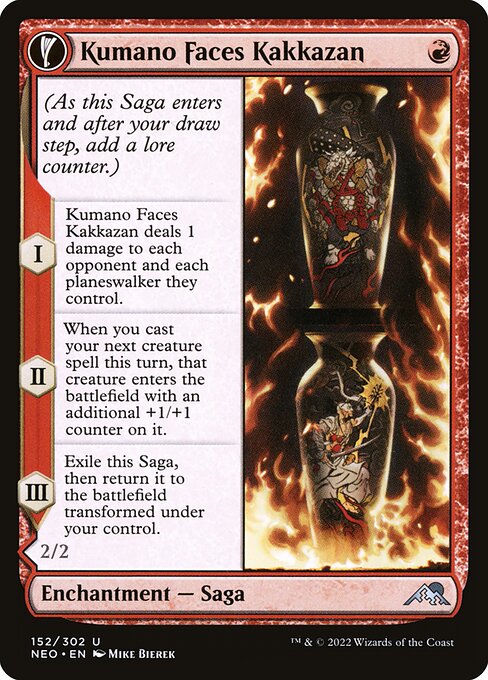 Kumano Faces Kakkazan
(As this Saga enters and after your draw step, add a lore counter.)
Kumano Faces Kakkazan
(As this Saga enters and after your draw step, add a lore counter.)
I — This Saga deals 1 damage to each opponent and each planeswalker they control.
II — When you next cast a creature spell this turn, that creature enters with an additional +1/+1 counter on it.
III — Exile this Saga, then return it to the battlefield transformed under your control.
. Mono-red decks will almost certainly still be a thing for years to come. Still, there’s a noticeable difference in the games where the red players doesn’t play the Enchantment turn one versus when they do. Getting to deal a damage, buff your next threat, and end with a 2/2 with Haste for one-mana is a lot to combat. Pumping your two-drop follow up can even put it outside of
Cut Down
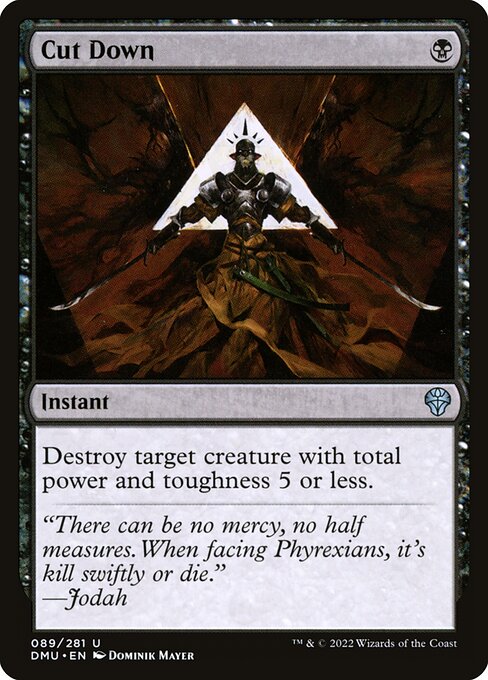 Cut Down
Destroy target creature with total power and toughness 5 or less.
or
Play with Fire
Cut Down
Destroy target creature with total power and toughness 5 or less.
or
Play with Fire
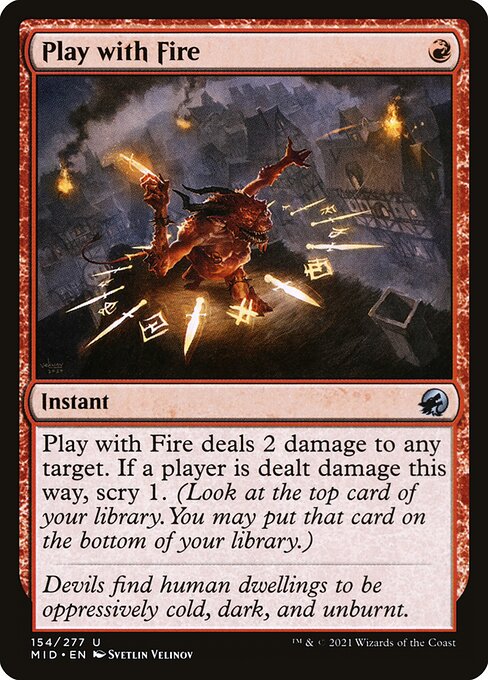 Play with Fire
 deals 2 damage to any target. If a player is dealt damage this way, scry 1. (Look at the top card of your library. You may put that card on the bottom.)
range!
Play with Fire
Play with Fire deals 2 damage to any target. If a player is dealt damage this way, scry 1. (Look at the top card of your library. You may put that card on the bottom.)
range!
The absence of
Raffine, Scheming Seer
Raffine, Scheming Seer
Flying, ward {1}
Whenever you attack, target attacking creature connives X, where X is the number of attacking creatures. (Draw X cards, then discard X cards. Put a +1/+1 counter on that creature for each nonland card discarded this way.)
will also serve as a major hinderance to Esper midrange decks moving forward. Most of these are cards have defined the Standard metagame for quite some time. The rotation should finally bring some much-needed change to what I believe has been a relatively stale format.
Read More: Thunder Junction Limited Data Showcases the Rise of Power Creep