


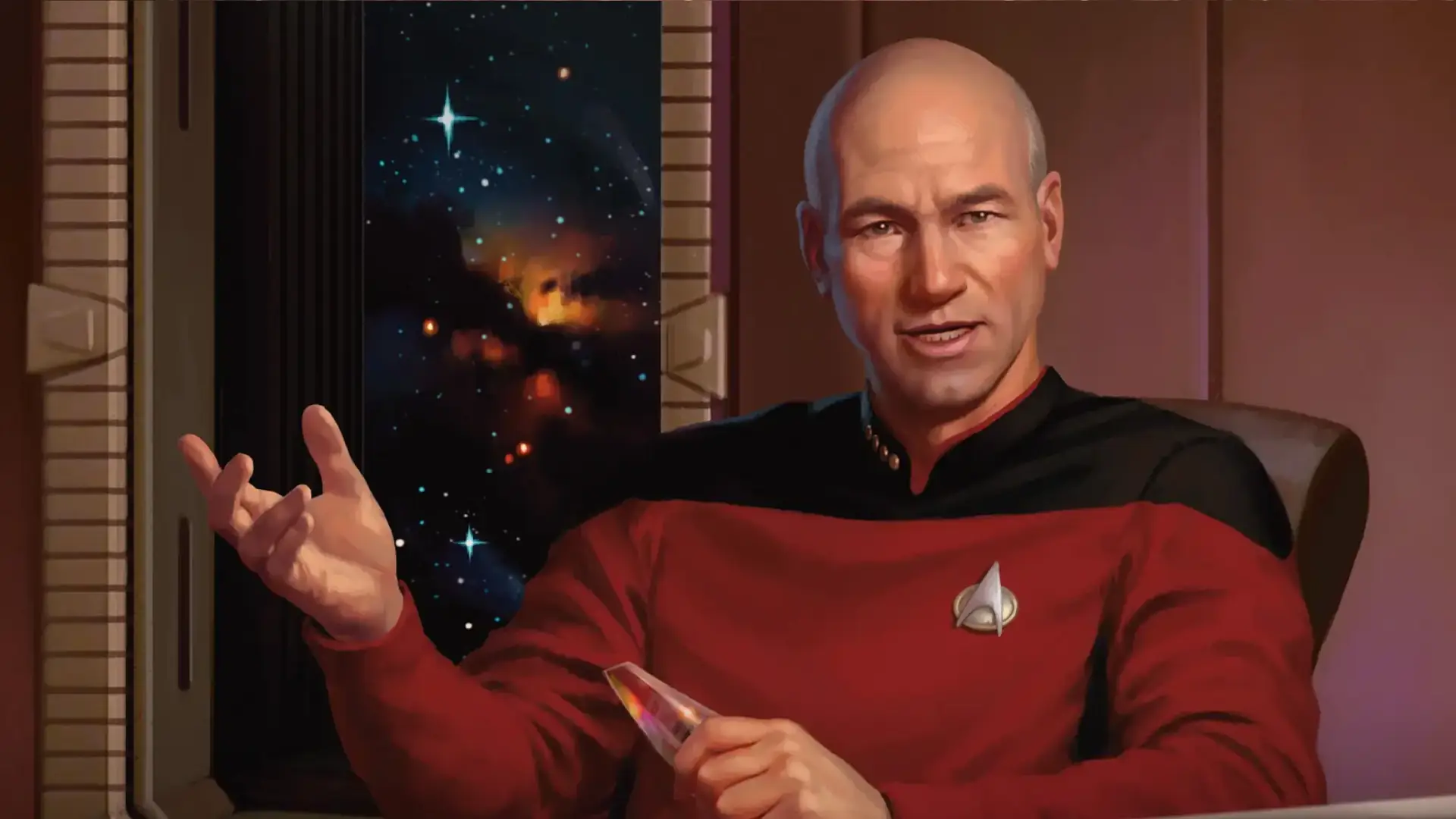

In the 33 years that MTG has been around for, Wizards of the Coast has created tons of creature types. So far, there are 324 unique creature types, and that number keeps growing with time.
While we’re used to seeing a set bring in a couple of new creature types, MTG Star Trek takes the cake. This set’s spoiler season isn’t even over, yet we’ve already seen 42 new creature types so far.
Given this dramatic shift, many MTG players have been wondering what on earth has gone on at Wizards. Thankfully, MTG Designer Gavin Verhey has recently explained what on earth is going on with MTG Star Trek.
We’re All Aliens in Space
In a recent Good Morning Magic short, Gavin Verhey explained how, in Star Trek, aliens aren’t really aliens. Since there’s no one central home world, there’s no reference point for who is and isn’t an Alien.
On top of this, the variety of species in Star Trek is one of the core parts of the franchise. If Wizards avoided this, an MTG Star Trek set wouldn’t feel like a Star Trek set.
With this in mind, it does make sense that every alien race in Star Trek is getting its own unique creature type. At the same time, it definitely feels weird that we’re getting so many new types all at once.
To make matters worse, the chances of any of these types returning are slim to none. Since Klingon and Borg don’t appear anywhere else, the only chance for more typal support is another Star Trek set.
Speaking of typal support, Wizards did sort of get around this through the Federation mechanic. This gave gameplay significance to the myriad new creature types, but again, that’s more of a one-and-done thing.
In isolation, then, MTG Star Trek definitely makes sense when you consider the franchise lore and the set’s mechanics. This set, however, doesn’t exist in isolation, and it flies in the face of MTG’s recent history.
Counterintuitive Creatures

While Wizards of the Coast has been slowly making more unique creature types, like Coyote and Slots, others have been disappearing. Back in 2024, Wizards errataed the Viashino type from MTG entirely, replacing them all with Lizards.
With the same happening to Cephalids, there are clearly times when Wizards strives for mechanical cohesion, over celebrating uniqueness. We continue to see this with new Beast cards; in fact, so it’s not like this is an old policy we’re clinging to.
Ultimately, while it can be useful mechanically, keeping things generic comes at the cost of flavor. Without unique types that feel distinctly Magic, cards and sets can feel that little bit less magical overall.
On the flip side, keeping things generic allows for better synergy with existing cards. Cat Typal has long been a well-supported archetype, for instance, but the new
M’Ress, Crew Coordinator
 M’Ress, Crew Coordinator
Landfall — Whenever a land you control enters, create two 1/1 red Officer creature tokens.
doesn’t fit into that.
Outside of the Borg, this problem affects a lot of the new MTG Star Trek cards, as they have limited typal synergies. Realistically, though, you can build around this hurdle, and the new mechanics that support Star Trek cards soften the blow.
The real trouble is more the optics of this change, as it feels like Universes Beyond is getting special treatment. Even if this makes sense for Star Trek, it stings when MTG players are still waiting on long-requested changes. It’s been years since Detective became a type, for instance, yet
Dogged Detective
 Dogged Detective
When this creature enters, surveil 2. (Look at the top two cards of your library, then put any number of them into your graveyard and the rest on top of your library in any order.)
Whenever an opponent draws their second card each turn, you may return this card from your graveyard to your hand.
still isn’t one.
The New Normal

Annoyingly, even if Universes Beyond sets get treated differently, this is the way MTG is now. With Universes Beyond being a core part of the calendar, not to mention a big money maker, Wizards needs to make those sets as good as possible.
In doing this, sets with lots of unique creature types will need those to be accurately represented in MTG. The same is also true for the abundance of unique characters that become legendary creatures, even if they don’t feel legendary.
Ultimately, even if it does raise some eyebrows, this is just how MTG is now, but don’t expect every set to be like Star Trek. As Verhey explained in his short, this set is very much a one-off for creature types like this.
Stick with us here at mtgrocks.com: the best site for Magic: The Gathering coverage. Be sure to check out our deckbuilder for your next big brew, and our MTG Rocks Podcast!