




While there’s no one best mechanic in MTG, if there ever were a competition, Landfall would definitely be up there. By turning the game’s fundamental resource into a value engine, this mechanic eliminates bad draws in the late game. Since the number of lands you can play is capped, too, many of these cards have absurd and abuseable abilities.
With this in mind, it should come as no surprise that Commanders like Phylath, World Sculptor can cause some serious shenanigans. Not only can this card create capable combos, but it’s a menace when played fairly, too. With so much power on offer, it’s baffling that this card sees so little play in the format.
MTG Phylath, World Sculptor

At first glance, Phylath, World Sculptor might seem too expensive to be a super-effective or even compelling Commander. While fast mana does address this problem, not going down this route just makes Phylath even more effective. Since it cares about the number of lands it plays when it enters, going slow isn’t a problem here.
Sadly, there is a wrinkle to this otherwise effective slow roll, as Phylath, World Sculptor only cares about basics. While you can still run non-basic lands, of course, cards like Rootpath Purifier become essential. Realistically, though, sticking to classic basic ramp cards like Cultivate, Rampant Growth, and Kodama’s Reach tends to be the play.
Beyond ramp spells, creatures that let you play multiple lands like Asuza, Lost but Seeking and Oracle of Mul Daya are essential. Unsurprisingly, the same is also true for Landfall staples like Lotus Cobra, Scute Swarm, and Rampaging Baloths. This deck will also want Ancient Greenwarden to double Landfall triggers while synergizing with Harrow and Roiling Regrowth.
Beyond being a basic-focused Landfall strategy, Phylath, World Sculptor also cares about plants. Naturally, this makes Avenger of Zendikar an auto-include, as is Rampant Rejuvenator. Technically, the same is also true for Bristly Bill, Spine Sower, Ouroboroid, and Cultivator Colossus, but they’re more Landfall than plant-focused cards.
If you do want to lean into Phylanth’s specific game plan, then token and trigger doublers are always a safe bet. Thankfully, you can’t really go wrong with Doubling Season and Roaming Throne. Technically, you could also dip into +1/+1 Counter synergies, too, but it’s better to stay lean and Landfall-focused.
All in all, it’s hard to go wrong with playing Phylath, World Sculptor fairly. Since lands are never dud draws, it’s easy to spiral out of control, especially with Guardian Project and Valakut Exploration fueling card draw. Even this fair game is just the tip of the iceberg, however, as Phylath, World Sculptor has some serious combo potential.
Infinite Mana, Plants, and Obvious Wins
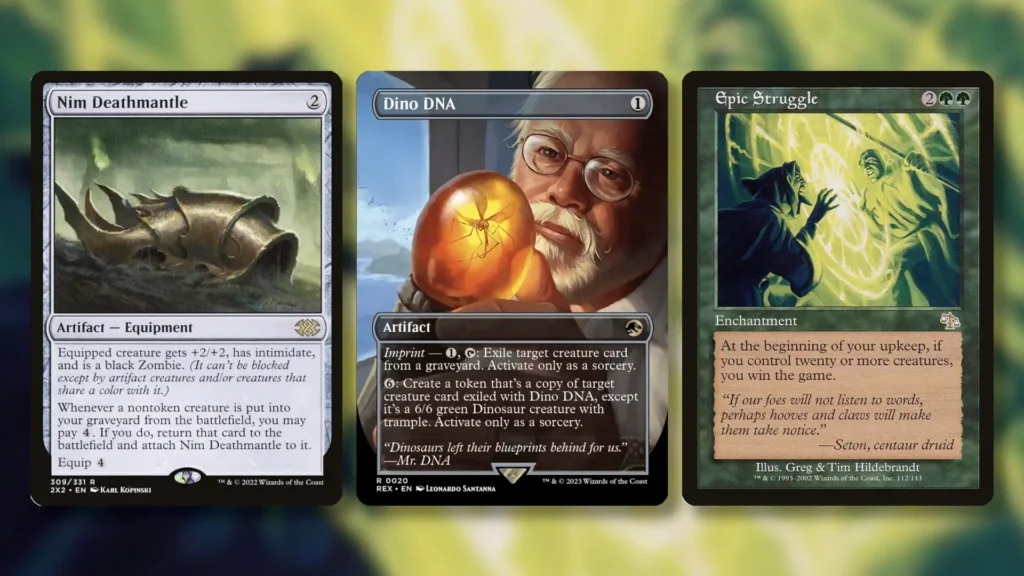
So long as you have a few basic lands in play, going infinite with Phylath, World Sculptor is remarkably easy. Alongside the classic pair of Nim Deathmantle and Ashnod’s/Phyrexian Altar, for instance, you can easily make infinite mana through your plant tokens. With either two or four basic lands in play, depending on the Altar, you’ll have enough plant tokens to pay Nim’s cost and loop Phylath.
While this combo can easily generate infinite mana for a Walking Ballista kill, extra lands also mean extra plants. Thanks to this, you could alternatively use Mass Hysteria to swing in for the win. Hell, since you’re in red, even the classic Impact Tremors is an option to ping each opponent to death.
If you’ve got mana to burn in the pursuit of consistency, similar combos are also possible with Cloudstone Curio and Dino DNA. Allowing you to bounce and copy Phylath, respectively, you’ll need six lands, at most, to create an infinite loop. Thankfully, while they’re not Landfall cards, these combo engines are pretty useful anyway, so the extra redundancy doesn’t hurt.
While these combos can generate infinite tokens for an Epic Struggle win, Orthion, Hero of Lavabrink can do the same for nine mana. So long as you have at least four lands, this card’s final ability will create at least 20 0/1 plants. Sadly, while this is perhaps the most novel way to win, your opponents are bound to see it coming as soon as Epic Struggle hits the board.
Basic but Not Boring
All in all, while Phylath, World Sculptor might not be the most powerful Landfall Commander, it’s undeniably interesting. The focus on basics, rather than just any land, is an interesting quirk that makes Phylath feel unique. Thankfully, this doesn’t come at the cost of the card’s power, too, as Phylath can easily keep up in bracket three games.
Despite this potential, Phylath, World Sculptor sees surprisingly little play in Commander. According to EDHREC, there are fewer than 2,300 decks that have Phylath in the command zone. While it is slightly more popular in the 99, appearing in around 27,400 lists, it’s by no means a staple.
Not only does this give Phylath, World Sculptor the upside of not being an expected threat, but it’s cheap, too. On TCGplayer, you can easily pick up a copy for just $0.35, and the showcase variant is even cheaper at $0.25. At these prices, it’s definitely a great budget pickup, although some Landfall staples can unfortunately be rather pricey.
Stick with us here at mtgrocks.com: the best site for Magic: The Gathering coverage. Be sure to check out our deckbuilder for your next big brew, and our brand new MTG Rocks Podcast!