




When looking for inspiration for unique Magic: The Gathering cards to try, you’d be surprised where you can find it. A massive amount of new product has caused Magic: The Gathering to look extremely different than what it did even ten years ago, causing a lot of cards to be lost to time. This is more true for competitive Magic than any of the game’s other modes of play. That might not be a place where you commonly look for Commander cards, but look far back enough, and you can find some gems.
A long time ago, Cadaverous Bloom, a forgotten Reserved List card, was the front face to an infamous combo deck. Despite its historical prevalence, the card has become long forgotten nowadays outside of Premodern. Considering how powerful its mana generation abilities are, this seems like a wasted opportunity for many MTG Commander players.
Cadaverous Bloom MTG
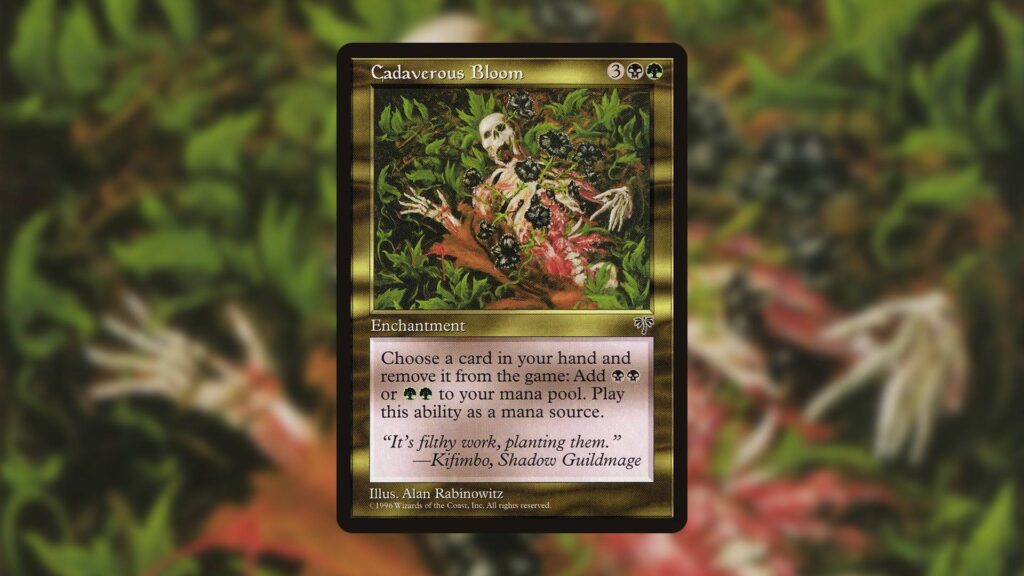
Cadaverous Bloom is a bit of a weird card on first glance. This is a rather expensive enchantment that just produces more mana, which rules it out of a lot of decks. That said, if you have the right support for it, Cadaverous Bloom produces tons of mana. If you really build around Bloom, you can even go infinite, proving that the ceiling of Bloom is not only extremely high, but it’s rather easy to break. So, while Bloom won’t be good in every Golgari Commander deck, if it works, you can easily win the game off the back of it.
Since this enchantment essentially turns cards in your hand into mana, Cadaverous Bloom excels with card draw engines over everything else. This means that the card performs exceptionally well in Commander decks like Damia, Sage of Stone. Since the Gorgon Wizard refills your hand, using cards as mana to accelerate your Commander out has no real downside. You’re also incentivized to empty your hand as often as possible to maximize Danitha, which Cadaverous Bloom is perfect for.
While Cadaverous Bloom barely sees any Commander play, this card is a somewhat common inclusion in Yargle and Multani decks. This may seem weird, since that Commander is just a gigantic vanilla creature, but the absurd stats on the card can be used to draw tons of cards. Cards like Rishkar’s Expertise and Greater Good, for example, draw 18 cards in a Yargle and Multani deck, which allows Cadaverous Bloom to do some absolutely ridiculous things. In a similar vein, Jenova, Ancient Calamity, and various permutations of The Gitrog Monster are other Commanders in Golgari colors capable of drawing tons of cards.
Tons of Two-Card Infinite Combos

Outside of big-mana Commander decks armed to draw tons of cards, Cadaverous Bloom also enables a whole bunch of two-card infinite combos that any tutor-heavy deck can splash. All of these combos involve using draw engines that need two mana, or less, to activate. Since Cadaverous Bloom exiles a card in your hand for two mana, these draw engines essentially become free, so long as you pay with a card in your hand.
This allows both Oath of Lim-Dul and Well of Knowledge to draw your entire deck in one go, opening the door for Thassa’s Oracle kills. You can also use some three-card combos, like Reassembling Skeleton, Skullclamp and Cadaverous Bloom to do the same things. This Skullclamp variant of the combo is doable with any recurrable one toughness creature, so long as you pay at least three mana to bring it back. Since most of these options end up being cheaper, you’re also gifted with infinite mana, or at least as much mana as you have cards to draw.
Skullclamp is a powerful enough card that it can easily become the centerpiece around which an entire deck is themed, providing more potential homes for Cadaverous Bloom. This card, for example, ends up being a great inclusion in Chatterfang, Squirrel General decks that focus on finding Skullclamp quickly. Meren of Clan Nel Toth, another deck that commonly leverages Skullclamp, may also be able to unlock the power of Cadaverous Bloom.
All of that said, the most powerful home for Cadaverous Bloom is likely Ad Nauseum decks. This is an extremely powerful Game Changer that basically only sees cEDH play. The card is so powerful that entire archetypes are born around finding it and using the instant to draw 30+ cards. You can’t always win on the turn you do this, however, which can make Cadaverous Bloom a lethal setup tool. Resolving an Ad Nauseum off the back of a Bloom is basically a death sentence.
The Second Coming of An Old Legend
Despite Cadaverous Bloom being forgotten by history, the card is still extremely powerful. There’s a ton of Commander decks that focus entirely on just drawing cards, and Bloom unlocks the potential to cast tons of cards for massive swingy turns.
If anything is holding Cadaverous Bloom back, aside from people not knowing about it, it’s likely the card’s color identity. Golgari isn’t really known as the card-drawing color combo, which means Bloom isn’t a card that many Commanders within its color identity want. If this were a mono-blue card, Cadaverous Bloom would likely be a Commander staple. Considering how powerful this card would be, it not being blue is probably a blessing in disguise.
Another slight deterrent is that Cadaverous Bloom isn’t exactly a budget option. $6 isn’t cheap, but it’s also far from the most expensive card in Magic. That said, there are plenty of worse condition copies of Cadaverous Bloom to choose from, meaning that finding a copy for $3 is very possible for a player on a budget. Throw in the fact that this card appears on the Reserved List, and the enchantment should easily pull its weight for its pricetag.
Stick with us at mtgrocks.com: the best place for Magic: The Gathering coverage!