


As a consistently rotating format, Standard isn’t always the easiest to keep up with. The format’s constant bans make things even worse, forcing through a new format in what feels like just a few months. While this can make it a bit intimidating to get into Standard, we’re here to make things a bit easier by highlighting the top archetypes in the format.
7 | Mardu Discard
Since the August 10th ban announcement, Mardu Discard, an aggressive deck that relies on discard synergies, has seen its popularity rise significantly. Both of your primary one-drops, Marauding Mako and Moonshadow, are capable of growing out of control when combined with discard outlets like Iron-Shield Elf and Hardened Academic.
While discarding cards in theory puts you behind on resources, cards like Bloodghast make the process less painful in attrition battles. Flashback cards like Practiced Offense play well to this, too, setting up combo kills with Cool but Rude. Card disadvantage doesn’t matter if the opponent is already dead!
Given how quickly Mardu Discard’s creatures can outsize burn spells, your matchups against decks like Izzet Spellementals and Mono-Red Aggro are pretty decent. While navigating around Dimir’s efficient removal suite isn’t as easy, landing a copy of Cool but Rude can singlehandedly win you the game.
Control decks with lots of removal and graveyard hate can be a challenge, but there’s no denying Mardu Discard is a powerful deck choice.
6 | Dimir Excruciator
Presenting one of the most unique gameplans in Standard, Dimir Excruciator is a traditional control deck that relies on a combo finish. Early in the game, efficient kill spells like Requiting Hex and Bitter Triumph help stave off early pressure, while Duress and Deceit help strip the opponent of important resources.
Eventually, after keeping the opponent off-balance long enough, your goal is to land Doomsday Excruciator, milling out your opponent with Restless Reef triggers the following turn. Notably, besides simply hard-casting Excruciator, you can also discard it and then cast Superior Spider-Man as a copy on the cheap.
With access to so much removal and win conditions that are hard to disrupt, Dimir Excruciator thrives versus most traditional creature decks. Unfortunately, Rest in Peace is a major liability, making sideboard games versus control and Azorius Tempo quite awkward.
5 | Dimir Midrange
At its core, Dimir Midrange is designed to out-tempo the opponent. Between evasive bodies like Dream Beavers and Spyglass Siren and interactive creatures like Floodpits Drowner and Wondrous Wasp, you want to establish an early advantage and keep it. Once you’re ahead on board, establishing Kaito, Bane of Nightmares or Enduring Curiosity takes over the game.
With lots of removal and hand disruption, Dimir Midrange excels against creature decks that rely heavily on individual, big bodies. At the same time, though, the lack of clean answers to Kaito from decks like Four-Color Control makes the matchup pretty strong as well.
Dimir Midrange is far from foolproof, however, as racing Sapling Nursery out of Mono-Green Landfall is nigh impossible. Without any way to reliably remove enchantments, fighting through Cool but Rude is also quite problematic.
4 | Jund Sacrifice

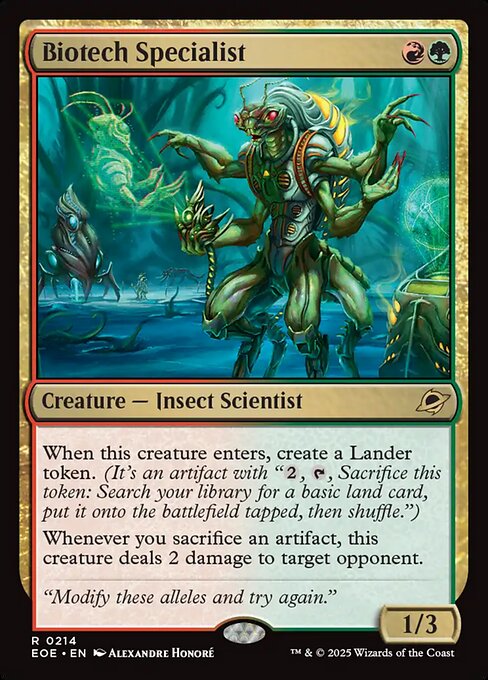
Standard’s new kid on the block, Jund Sacrifice revolves around Edge of Eternities’
Biotech Specialist
 Biotech Specialist
When this creature enters, create a Lander token. (It's an artifact with "{2}, {T}, Sacrifice this token: Search your library for a basic land card, put it onto the battlefield tapped, then shuffle.")
Biotech Specialist
When this creature enters, create a Lander token. (It's an artifact with "{2}, {T}, Sacrifice this token: Search your library for a basic land card, put it onto the battlefield tapped, then shuffle.")
Whenever you sacrifice an artifact, this creature deals 2 damage to target opponent.
and the new
The Sackville-Bagginses
 The Sackville-Bagginses
When The Sackville-Bagginses enter, you may sacrifice another creature or artifact. If you do, draw a card and create a Treasure token.
The Sackville-Bagginses
When The Sackville-Bagginses enter, you may sacrifice another creature or artifact. If you do, draw a card and create a Treasure token.
Whenever you sacrifice a token, target opponent loses 1 life.
from The Hobbit. With these in play, sacrificing an artifact deals a massive three damage to your opponent, ending games out of nowhere. With cards like
Greedy Freebooter
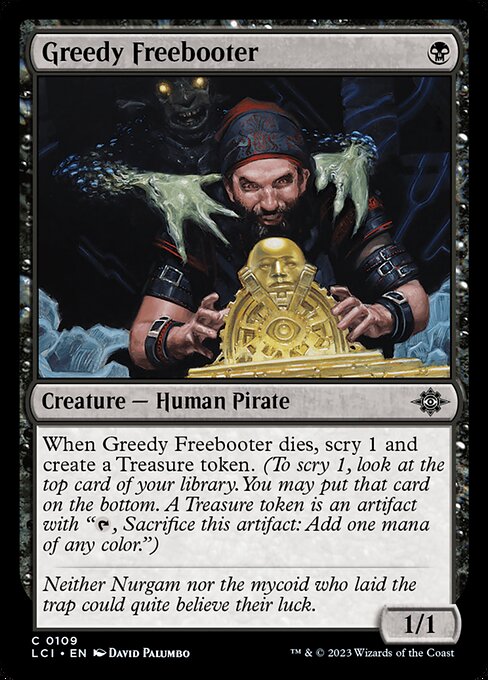 Greedy Freebooter
When this creature dies, scry 1 and create a Treasure token. (To scry 1, look at the top card of your library. You may put that card on the bottom. A Treasure token is an artifact with "{T}, Sacrifice this token: Add one mana of any color.")
and
Obsessive Pursuit
Greedy Freebooter
When this creature dies, scry 1 and create a Treasure token. (To scry 1, look at the top card of your library. You may put that card on the bottom. A Treasure token is an artifact with "{T}, Sacrifice this token: Add one mana of any color.")
and
Obsessive Pursuit
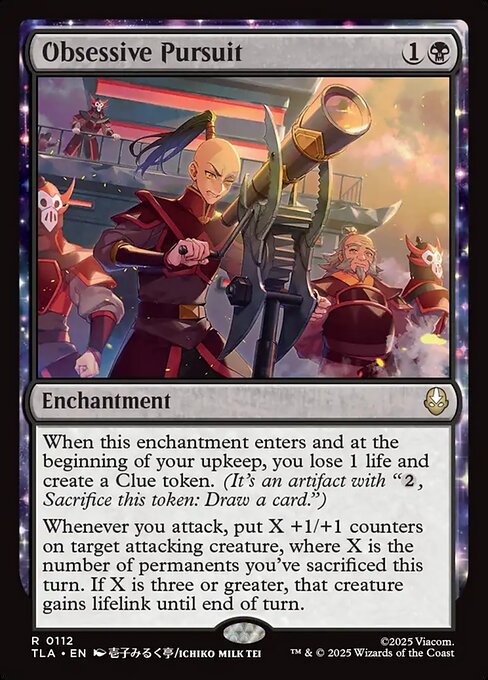 Obsessive Pursuit
When this enchantment enters and at the beginning of your upkeep, you lose 1 life and create a Clue token. (It's an artifact with "{2}, Sacrifice this token: Draw a card.")
Obsessive Pursuit
When this enchantment enters and at the beginning of your upkeep, you lose 1 life and create a Clue token. (It's an artifact with "{2}, Sacrifice this token: Draw a card.")
Whenever you attack, put X +1/+1 counters on target attacking creature, where X is the number of permanents you've sacrificed this turn. If X is three or more, that creature gains lifelink until end of turn.
generating tons of artifact tokens, you’ll have tons of gas to sacrifice to
Umbral Collar Zealot
 Umbral Collar Zealot
Sacrifice another creature or artifact: Surveil 1. (Look at the top card of your library. You may put it into your graveyard.)
, dealing massive waves of damage.
Umbral Collar Zealot
Sacrifice another creature or artifact: Surveil 1. (Look at the top card of your library. You may put it into your graveyard.)
, dealing massive waves of damage.
Early results suggest Jund Sacrifice might be the best deck in Standard, with positive matchups against everything except hyper-aggressive strategies like Boros Dwarves. That said, matchup data for this archetype is currently very limited, and the metagame is only starting to adapt to this new strategy.
For now, the deck’s dominance remains a question mark, but Standard RCQ players will need to be prepared for it.
3 | Four-Color Control

As you’d expect from a control deck, Four-Color Control is built to disrupt the opponent with cards like Firebending Lesson and Get Lost, stalling for a game-winning bomb. In this case, the bomb of choice is none other than Jeskai Revelation, an instant that completely swings games in your favor. Between using Tablet of Discovery as ramp and card advantage engines like Stock Up, you’ll be able to find and cast this card consistently.
Thanks to literally being a deck full of removal, Four-Color Control excels at keeping creature-focused aggressive strategies in check. Between lots of graveyard hate and the deck’s lower threat count, Izzet Spellementals is also quite advantageous. If it weren’t for this deck’s weakness to Mono-Green Landfall’s grindy tools like Sapling Nursery and Earthbender Ascension, Four-Color Control would likely be even more dominant.
2 | Izzet Spellementals

Since the banning of Stormchaser’s Talent, many Izzet mages have flocked (no pun intended) to the grindier Spellementals shell. This deck is looking to spend its early turns casting cantrips and cheap removal spells like Burst Lightning to stay afloat. All the while, your graveyard quickly fills up, significantly reducing the cost of Eddymurk Crab and Hearth Elemental.
Not only do these threats have the upside of outsizing Requiting Hex and most burn spells, but they also enable Sunderflock as a brutal follow-up. Easily castable for just two mana, this Elemental completely flips the script against creature decks, winning the game on its own.
With this in mind, this is one of the few archetypes with a positive Mono-Green Landfall matchup, which alone gives it tons of stock in Standard. Unfortunately, with so few threats at your disposal and an inability to apply early pressure, your matchups versus control and Dimir Excruciator suffer.
1 | Mono-Green Landfall
With the now-banned Badgermole Cub being the only card keeping it in check, Mono-Green Landfall has taken over the format thanks to its multi-angle attack. On one hand, this deck can combine Mightform Harmonizer with lands like Fabled Passage that provide multiple Landfall triggers as a combo kill. With accelerants like Llanowar Elves available, turn four kills are common.
Yet, against slower decks, Landfall can lean on grindy tools like Sapling Nursery and Esper Origins to overwhelm the opponent’s removal. With Ba Sing Se generating virtually endless threats, Landfall’s late game is just as powerful as its combo kills. Throw in Earthbender Ascension as a buff effect for even your puniest of creatures, and it’s easy to see why this deck has few weaknesses.
This gives Landfall a strong matchup against all of Standard’s Midrange and control decks, which happens to be the vast majority of the format. Extremely aggressive starts from Mardu Discard can occasionally get under Landfall, but this matchup feels relatively even. Even Mono-Green’s lone bad Spellementals matchup isn’t impossible, thanks to Mossborn Hydra dodging Sunderflock.
Between having strong matchups against almost all Standard decks and only one truly bad matchup, Mono-Green Landfall is unquestionably the best deck in Standard.
Stick with us here at mtgrocks.com: the best site for Magic: The Gathering coverage. Be sure to check out our deckbuilder for your next big brew, and our brand new MTG Rocks Podcast!