


With MTG’s most powerful formats shaped around them, artifacts offer some of the most powerful cards that the game has ever seen. Between infinite turn engines and absurd mana rocks, the card type can help you close a game as soon as it starts. This makes it quite difficult to narrow down the absolute best artifacts of all time, but here, we’ve set out to do just that.
Here are our top picks for the best artifacts in MTG.
10 | Skullclamp
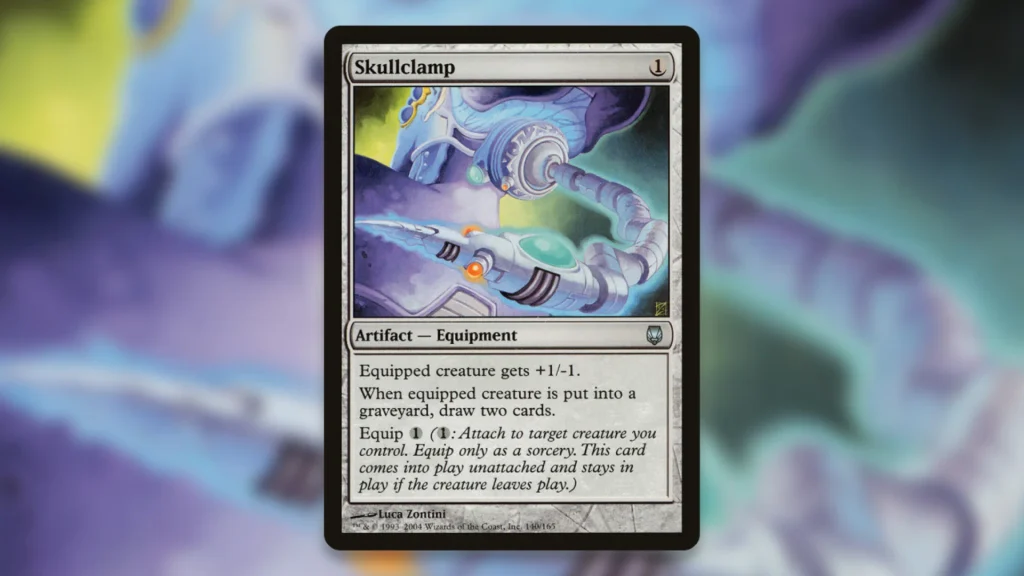
Like many of the best cards in MTG, Skullclamp was a design mistake on Wizards of the Coast’s part. While it was intended to simply reward a player when their equipped creature dies, Skullclamp becomes absolutely broken when used with one-toughness creatures. As a result, Skullclamp was quickly banned in Legacy, and pre-banned in Modern.
That leaves Commander as the main place that players use Skullclamp, where it commonly appears in just about every deck that has a high creature count. Thanks to this, Skullclamp sees play in over one million Commander decks according to EDHREC, and is the third-most played equipment in the entire game.
Outside of traditional Commander, Skullclamp is also strong in Duel Commander, particularly with
Cloud, Midgar Mercenary
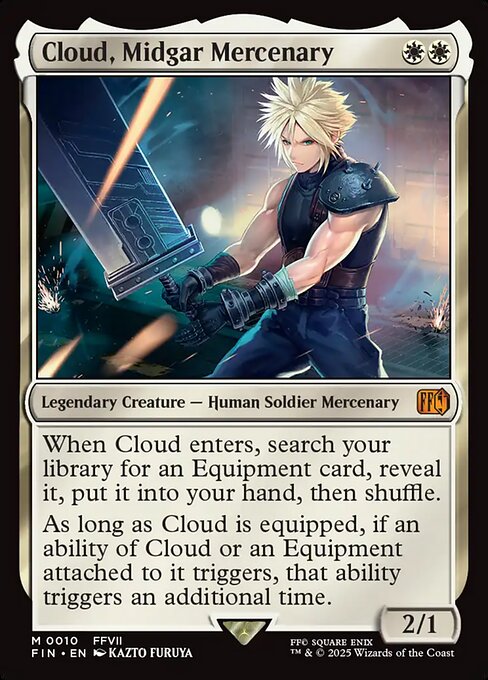 Cloud, Midgar Mercenary
When Cloud enters, search your library for an Equipment card, reveal it, put it into your hand, then shuffle.
Cloud, Midgar Mercenary
When Cloud enters, search your library for an Equipment card, reveal it, put it into your hand, then shuffle.
As long as Cloud is equipped, if a triggered ability of Cloud or an Equipment attached to it triggers, that ability triggers an additional time.
. Capable of searching for the equipment and drawing four cards with it, this Commander perfectly demonstrates why Skullclamp was considered a design mistake. The card is also unrestricted in Vintage, but has dropped off in play rate after
Monastery Mentor
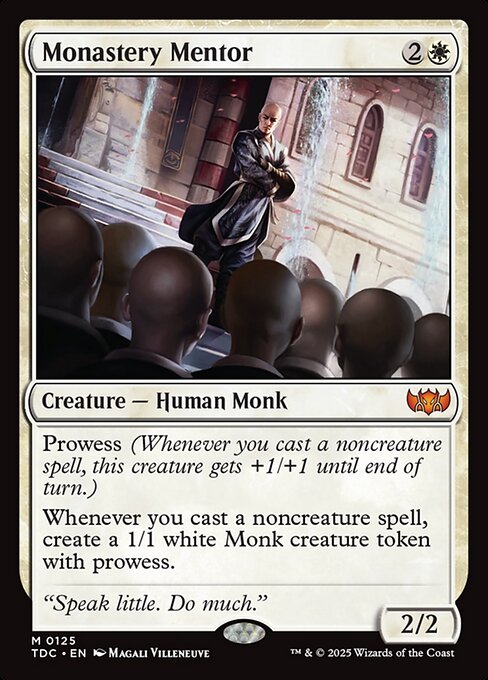 Monastery Mentor
Prowess (Whenever you cast a noncreature spell, this creature gets +1/+1 until end of turn.)
Monastery Mentor
Prowess (Whenever you cast a noncreature spell, this creature gets +1/+1 until end of turn.)
Whenever you cast a noncreature spell, create a 1/1 white Monk creature token with prowess.
was restricted to one copy.
9 | Mana Vault

Most of Magic’s best artifacts are cards that give you a massive boost of mana in the early game, essentially accelerating you multiple turns ahead of your opponent. Mana Vault is the most tame example on this list, giving you an immediate burst of three mana for just one of your own. This easily enables you to cast a five-drop as early as turn two, getting extremely far ahead of your opponents.
Because of its expensive untap cost, Mana Vault is generally a one-use artifact in the early game, but there are ways to get around that. Cards like
Manifold Key
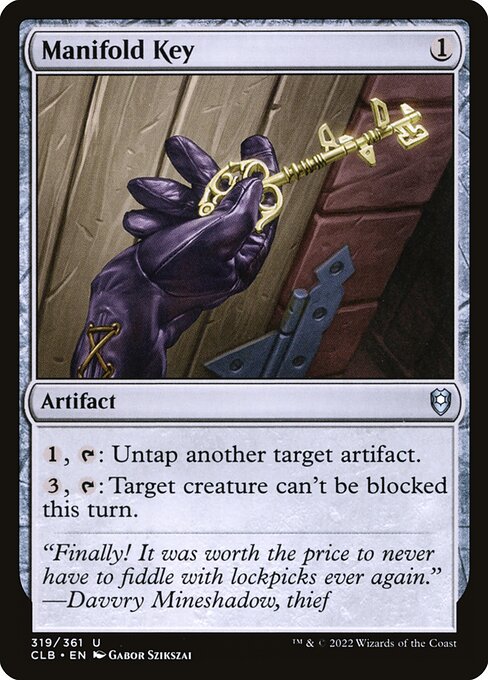 Manifold Key
{1}, {T}: Untap another target artifact.
Manifold Key
{1}, {T}: Untap another target artifact.
{3}, {T}: Target creature can't be blocked this turn.
or
Tezzeret, Cruel Captain
 Tezzeret, Cruel Captain
Whenever an artifact you control enters, put a loyalty counter on Tezzeret.
Tezzeret, Cruel Captain
Whenever an artifact you control enters, put a loyalty counter on Tezzeret.
0: Untap target artifact or creature. If it's an artifact creature, put a +1/+1 counter on it.
−3: Search your library for an artifact card with mana value 1 or less, reveal it, put it into your hand, then shuffle.
−7: You get an emblem with "At the beginning of combat on your turn, put three +1/+1 counters on target artifact you control. If it's not a creature, it becomes a 0/0 Robot artifact creature."
can untap Mana Vault for cheap, giving you a steady stream of mana to use turn after turn. If you don’t find an untapper, you can also use cards like
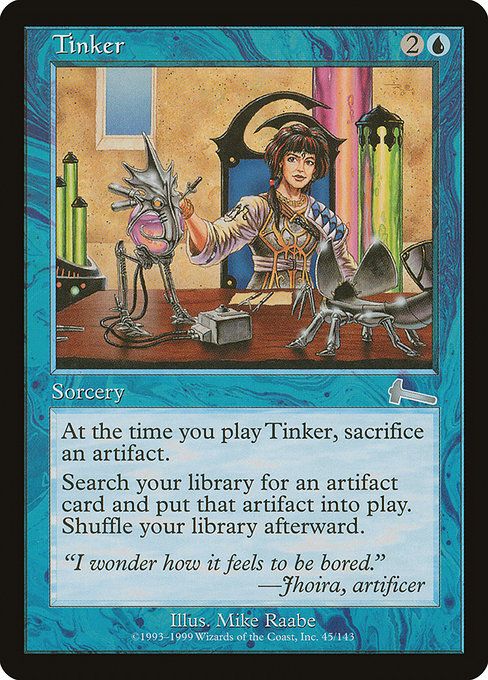
Tinker
 Tinker
As an additional cost to cast this spell, sacrifice an artifact.
Tinker
As an additional cost to cast this spell, sacrifice an artifact.
Search your library for an artifact card, put that card onto the battlefield, then shuffle.
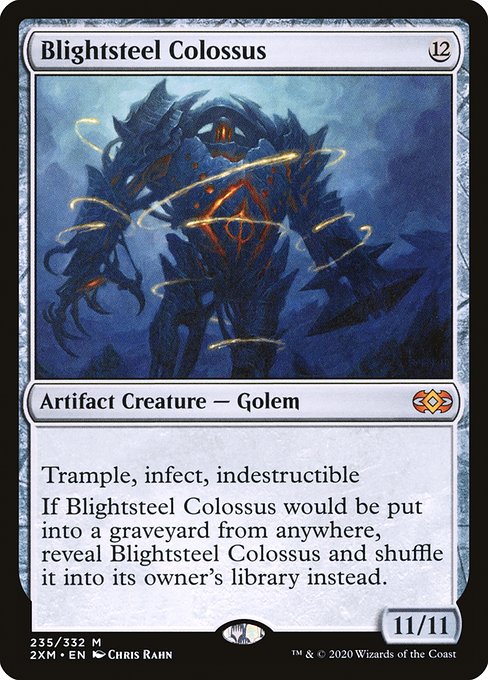
in Vintage to repurpose your seemingly useless mana rock into a
Blightsteel Colossus
 Blightsteel Colossus
Trample, infect, indestructible
Blightsteel Colossus
Trample, infect, indestructible
If Blightsteel Colossus would be put into a graveyard from anywhere, reveal Blightsteel Colossus and shuffle it into its owner's library instead.
.
Even when you aren’t building around it, Mana Vault’s ability to accelerate your mana in the opening turns makes it one of the most broken cards in MTG. Thanks to this, the card sees tons of play in Commander as a Game Changer, appearing in over 563,000 decks according to EDHREC. The card has otherwise been banned in Legacy and Oathbreaker, in addition to being restricted in Vintage.
8 | Sensei’s Divining Top
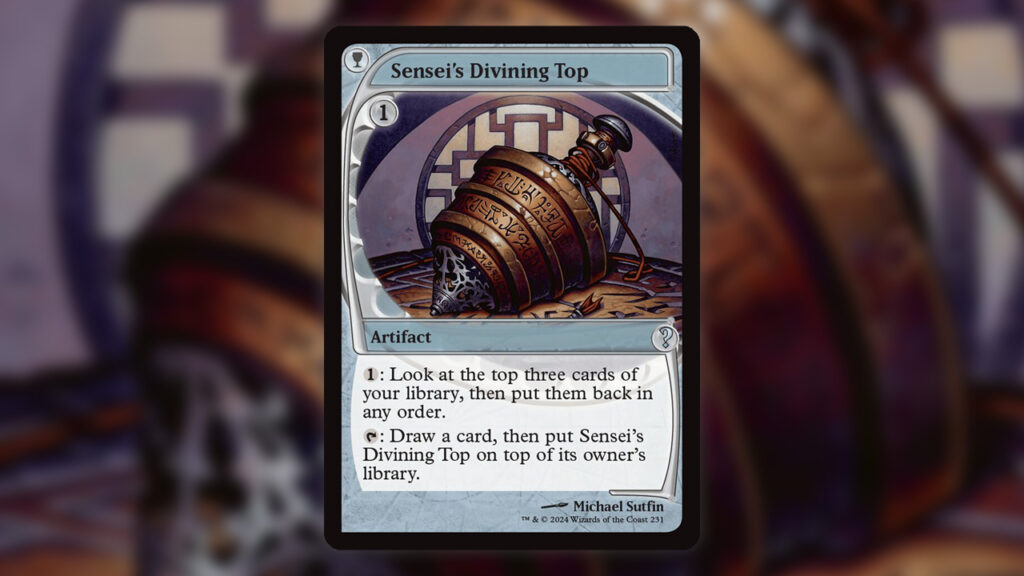
Sensei’s Divining Top is both an extremely powerful artifact and a cause of equally unhealthy play patterns. While organizing the top of your library may seem innocuous, Top pairs extremely well with common effects that shuffle your library, like Fetch Lands. The ability to constantly manipulate your draw also pairs well with powerful effects that care about the top of your deck, like Miracle cards.
Among the cards that care about the top of your library, however,
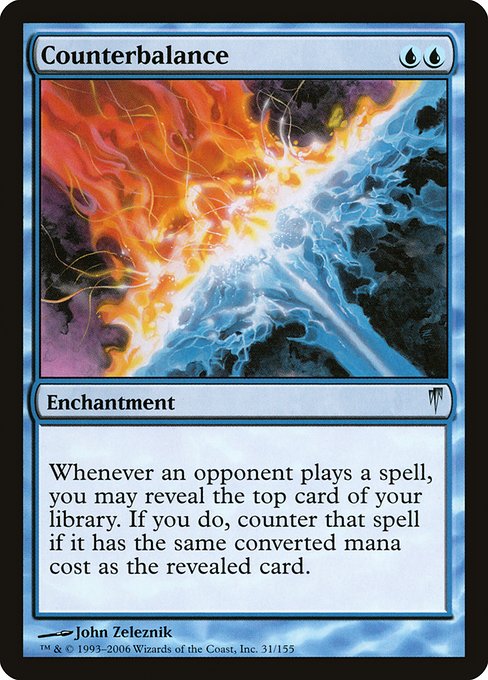
Counterbalance
 Counterbalance
Whenever an opponent casts a spell, you may reveal the top card of your library. If you do, counter that spell if it has the same mana value as the revealed card.
was the most problematic one. By using the Top to put the perfect card on top of your library, Counterbalance could essentially counter every small card your opponents play. This caused Legacy Counterbalance Miracles to be the best deck in the format until Sensei’s Divining Top’s ban, but this card’s issues don’t stop there.
Counterbalance
Whenever an opponent casts a spell, you may reveal the top card of your library. If you do, counter that spell if it has the same mana value as the revealed card.
was the most problematic one. By using the Top to put the perfect card on top of your library, Counterbalance could essentially counter every small card your opponents play. This caused Legacy Counterbalance Miracles to be the best deck in the format until Sensei’s Divining Top’s ban, but this card’s issues don’t stop there.
While this combo was particularly toxic, Sensei’s Divining Top also caused a speed-of-play issue. The card essentially encourages players to rearrange their library every turn, potentially multiple times. These decisions often weren’t easy to make either, which slowed down the speed of competitive play considerably. For slowing down tournament play far too much, Sensei’s Divining Top also saw a ban in Modern.
Nowadays, the Top is still an extremely popular card in Commander, where it enables some of the most broken infinite combos in the game. Any card that allows you to play an artifact from the top of your deck, like
Mystic Forge
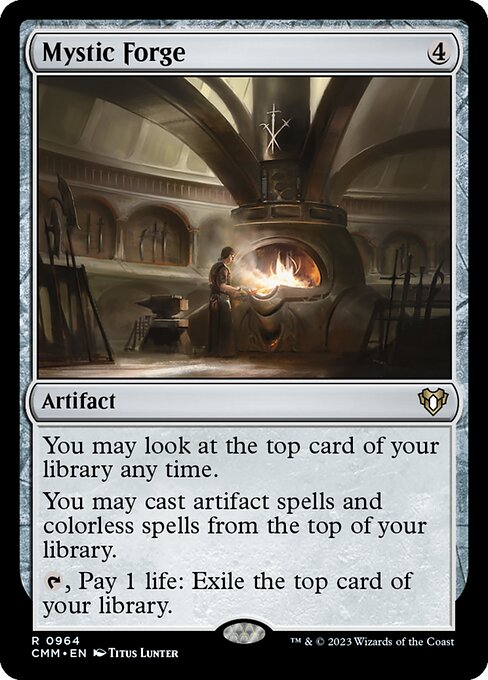 Mystic Forge
You may look at the top card of your library any time.
Mystic Forge
You may look at the top card of your library any time.
You may cast artifact spells and colorless spells from the top of your library.
{T}, Pay 1 life: Exile the top card of your library.
, often allows Top to draw your entire deck. All you need is a cost reducer, like
Glaring Fleshraker
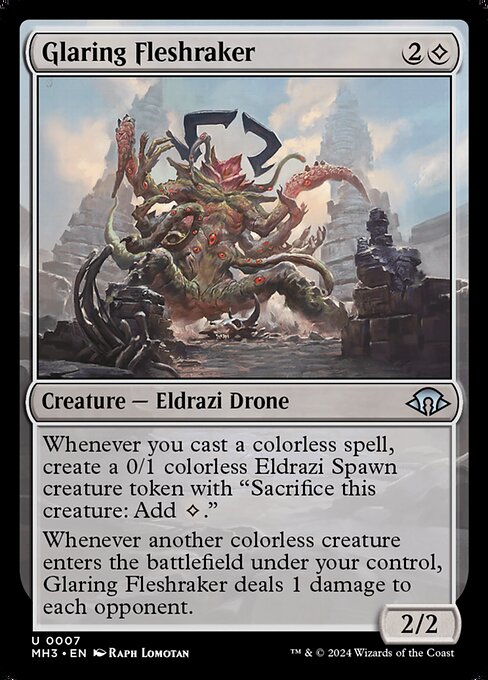 Glaring Fleshraker
Whenever you cast a colorless spell, create a 0/1 colorless Eldrazi Spawn creature token with "Sacrifice this token: Add {C}."
Glaring Fleshraker
Whenever you cast a colorless spell, create a 0/1 colorless Eldrazi Spawn creature token with "Sacrifice this token: Add {C}."
Whenever another colorless creature you control enters, this creature deals 1 damage to each opponent.
or
Foundry Inspector
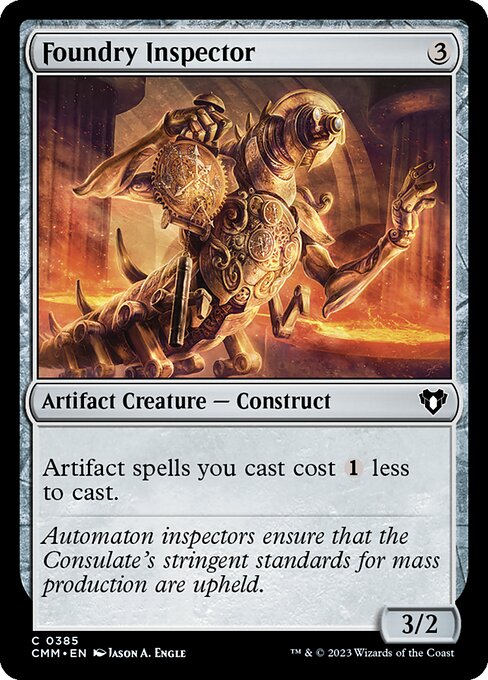 Foundry Inspector
Artifact spells you cast cost {1} less to cast.
, and winning becomes trivial.
Foundry Inspector
Artifact spells you cast cost {1} less to cast.
, and winning becomes trivial.
Between its combo potential and just being a fantastic consistency booster, Sensei’s Divining Top sees play in over 434,000 decks according to EDHREC. There, it continues to make one player way slower than the rest, but that’s not quite as bad in a more casual setting.
7 | The One Ring
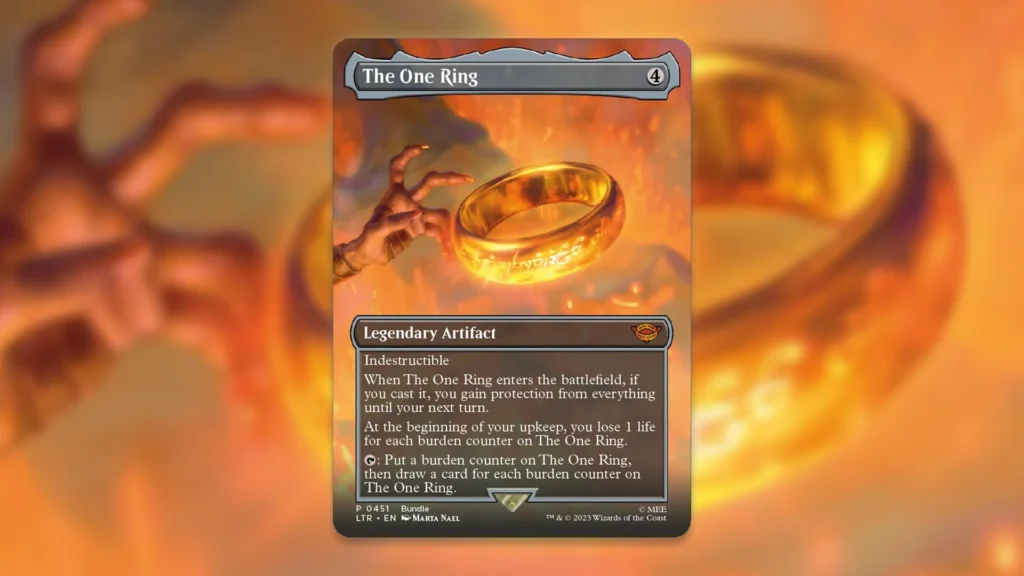
The One Ring is the perfect MTG draw engine, often capable of winning the game on its own. The card’s Protection effect plays a huge role here, removing the downside of playing a card that doesn’t immediately impact the board. With the ability to entirely ignore your opponent’s board for a turn, you’ll have plenty of opportunity to bury your opponent with extra cards.
While The One Ring is already fantastic without building around it, doing so breaks the card, often drawing your entire deck. Untappers like
Manifold Key
Manifold Key
{1}, {T}: Untap another target artifact.
{3}, {T}: Target creature can't be blocked this turn.
can often draw tons of extra cards, while
Mind Over Matter
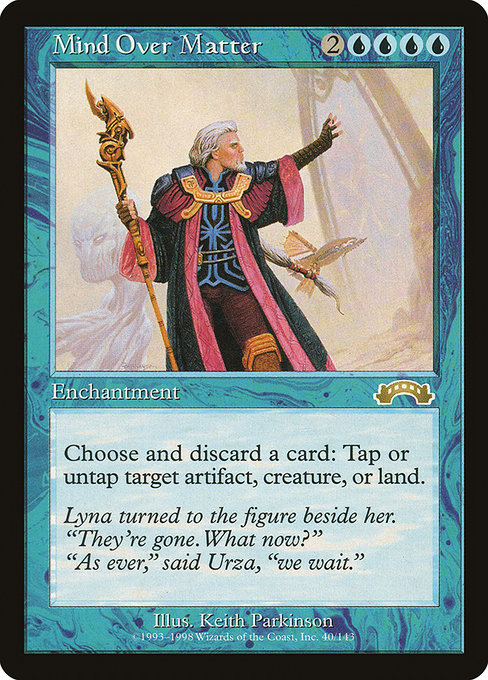 Mind Over Matter
Discard a card: You may tap or untap target artifact, creature, or land.
can go infinite on the spot. You can even bounce The One Ring repetitively with
Meticulous Excavation
Mind Over Matter
Discard a card: You may tap or untap target artifact, creature, or land.
can go infinite on the spot. You can even bounce The One Ring repetitively with
Meticulous Excavation
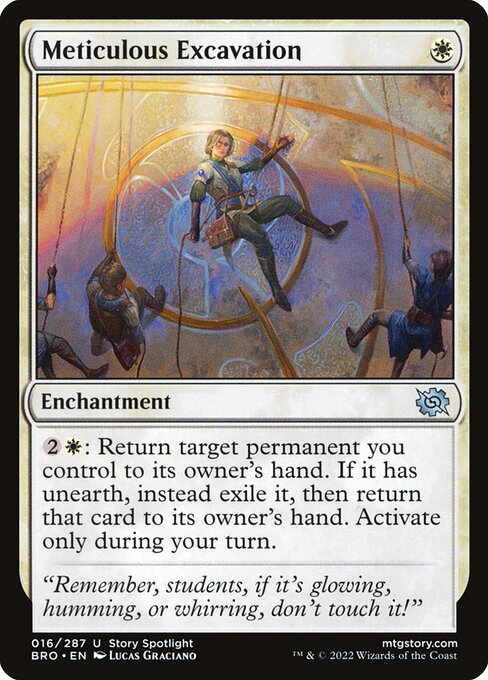 Meticulous Excavation
{2}{W}: Return target permanent you control to its owner's hand. If it has unearth, instead exile it, then return that card to its owner's hand. Activate only during your turn.
for infinite protection, or use extra copies of the card to reset your Burden Counters.
Meticulous Excavation
{2}{W}: Return target permanent you control to its owner's hand. If it has unearth, instead exile it, then return that card to its owner's hand. Activate only during your turn.
for infinite protection, or use extra copies of the card to reset your Burden Counters.
Thanks to all of this, The One Ring was banned in Modern and nerfed in MTG Arena’s Historic format. The card otherwise remains playable in Legacy and Vintage, where the formats’ speed and free countermagic can keep up with this powerhouse.
Of course, The One Ring is also a Game Changer in Commander, where it could easily upgrade each and every MTG deck. If it weren’t for the card’s sky-high price tag, The One Ring would likely see far more play here, currently appearing in over 785,000 different decks.
6 | The Fantasticar
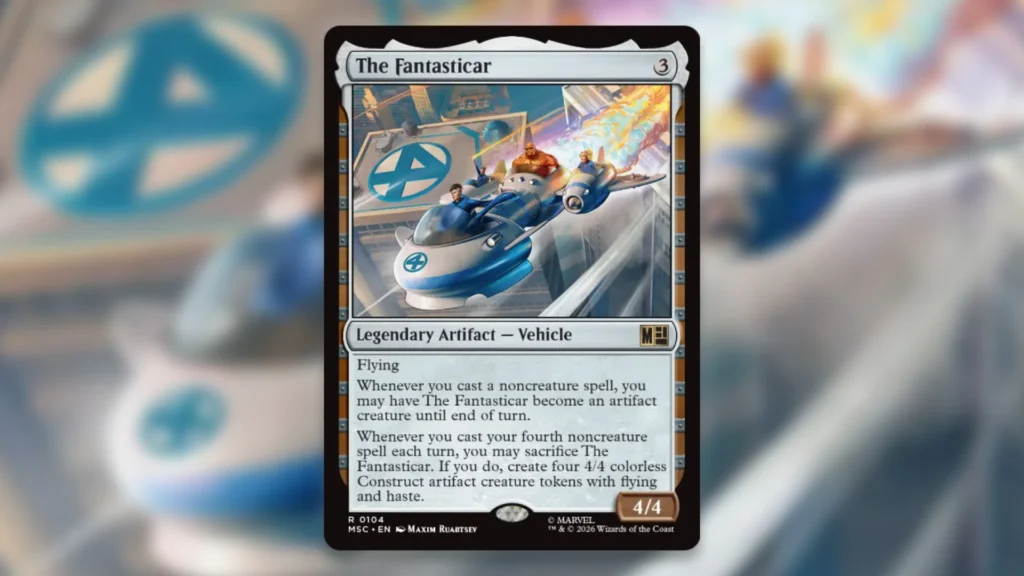
Commonly seen on recent MTG ban announcements, The Fantasticar is Wizards of the Coast’s latest design mistake, absolutely breaking two-player formats like Legacy and Vintage. Thanks to an abundance of fast mana and free spells, casting four noncreature spells in your opening turn is surprisingly easy. Sadly, dealing with 16 Flying Haste power on turn one is far more difficult.
Because of this, The Fantasticar saw a quick ban in Legacy, Duel Commander, and a Vintage restriction after being legal for a little over a month. Homogeneity was a massive issue here, with the artifact appearing as an alternate win condition in every manner of combo deck alongside Affinity piles. Despite this, The Fantasticar remains playable in Commander, where the card is rather unremarkable.
5 | Original Moxen
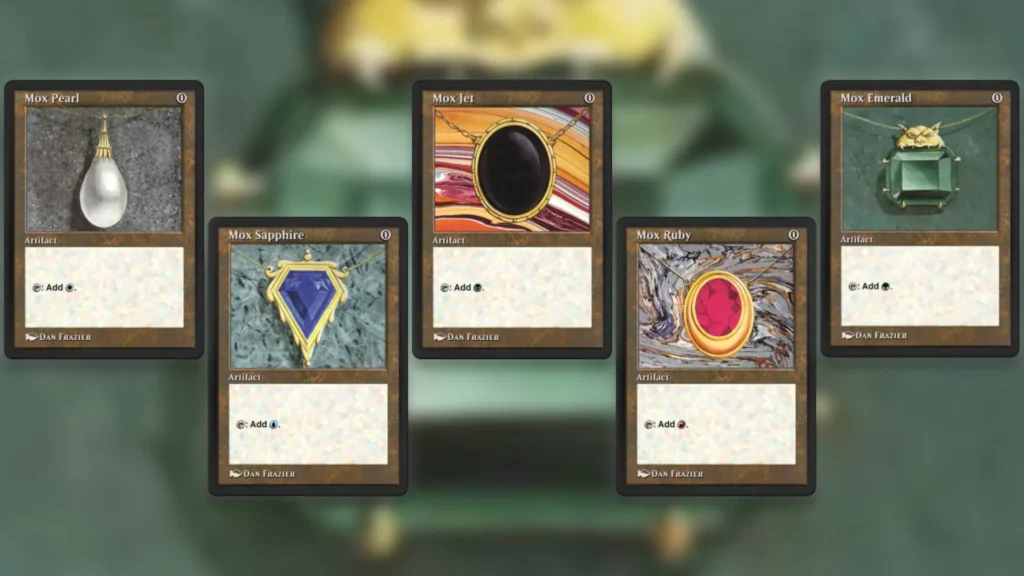
Essentially, the five original MTG Moxen are additional colored land drops that you can play outside of the once-per-turn rule. The mana advantage these cards offer is already broken, but in strategies focused on abusing the Moxen, things quickly become much worse.
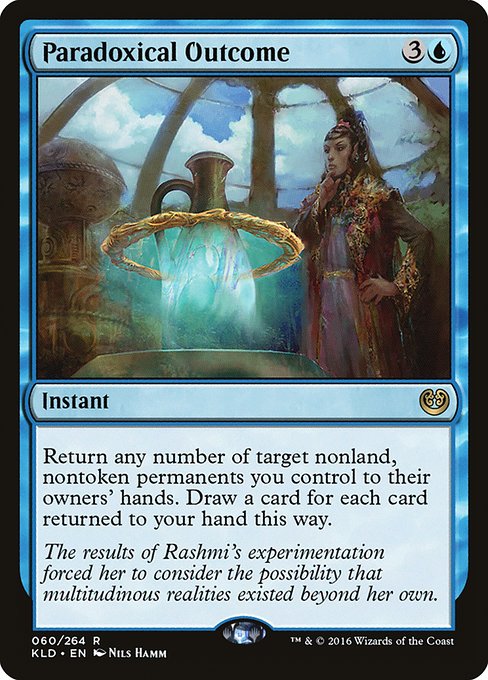
Bouncing the Moxen with cards like
Paradoxical Outcome
 Paradoxical Outcome
Return any number of target nonland, nontoken permanents you control to their owners' hands. Draw a card for each card returned to your hand this way.
, for example, can both refill your hand and double up on the mana these Moxen produce. Alternatively, cards like
Mystic Forge
Mystic Forge
You may look at the top card of your library any time.
Paradoxical Outcome
Return any number of target nonland, nontoken permanents you control to their owners' hands. Draw a card for each card returned to your hand this way.
, for example, can both refill your hand and double up on the mana these Moxen produce. Alternatively, cards like
Mystic Forge
Mystic Forge
You may look at the top card of your library any time.
You may cast artifact spells and colorless spells from the top of your library.
{T}, Pay 1 life: Exile the top card of your library.
can play your Moxen off the top of your deck, making them free card advantage and mana. Considering this, it’s no wonder the five Moxen are considered to be part of the Power Nine, the strongest cards in MTG history.
Of course, the Moxen all fall into the category of cards that make every MTG deck better just for playing them. Because of this, the original Moxen are only playable in formats that cannot ban cards, like Vintage and Canadian Highlander, under extremely heavy restrictions.
4 | Mana Crypt
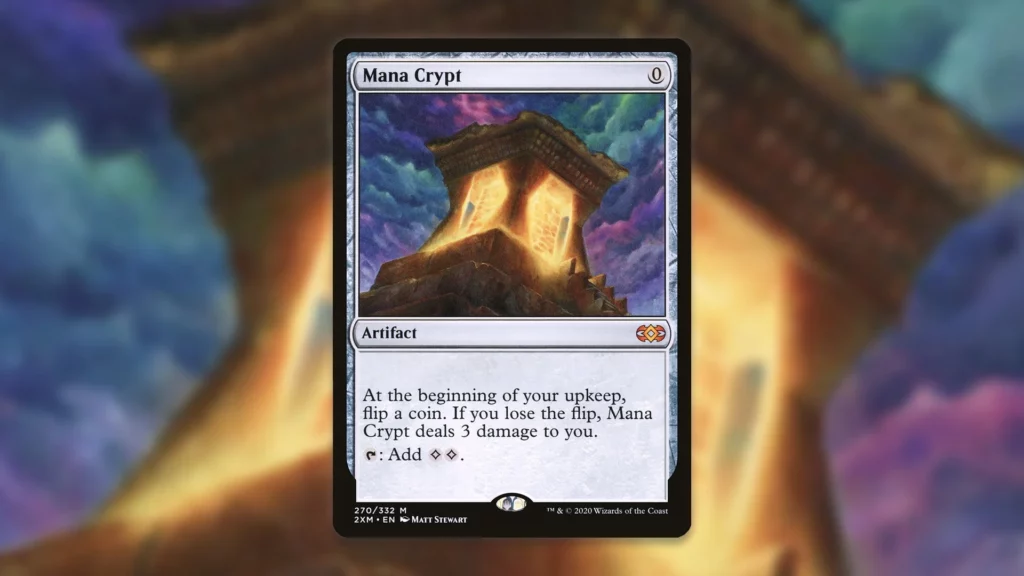
Offering a two-mana boost for free, Mana Crypt is undeniably one of the best mana accelerants in all of MTG. So long as you play this card in your opening turns, you should easily be able to establish your board far quicker than your opponents. Sure, the card’s downside can occasionally cost you longer games, but compared to the upside, some occasional damage is quite laughable.
Mana Crypt’s immediate mana advantage is so good, in fact, that the card is no longer playable in any format that can ban MTG cards. It remained legal in Commander for quite some time, but was quite controversially banned back in 2024. Now, you can play Mana Crypt as a one-of in Vintage, where it appears in many faster strategies, or in Canadian Highlander for half your point allotment.
3 | Sol Ring

Sol Ring is, debatably, the best MTG artifact of them all, essentially accelerating you two turns ahead as early as turn one. While this is obviously insanely powerful, Sol Ring’s lack of downsides is what really pushes it over the top, giving you a permanent ramp piece with no caveats. Heck, Sol Ring even generates more mana than it costs to cast, making every deck it appears in just a bit faster.
Because of this, Sol Ring has, rightfully, been banned in Legacy and Oathbreaker, while being Restricted in Vintage. The card also costs three points to use in Canadian Highlander, reinforcing its position as one of the best cards in the game.
Commander is the only format where Sol Ring can be used without a catch, thanks to the card’s role in the format’s identity. Seeing play in over a staggering eight million decks according to EDHREC, this is the most played card in all of Commander, and for good reason. Frankly, as far as power level goes, this card should be banned in Commander, but that will likely never happen.
2 | Time Vault

Back when it was released in 1993, Time Vault wasn’t just a fair card; it was, debatably, quite bad. While taking extra turns is one of the most powerful things you can do in Magic, giving up a turn to get one is an absolutely disastrous downside. Of course, like many of Magic’s problematic cards, cards printed decades later would allow Time Vault to ignore its downside, making it one of the most broken cards in history.
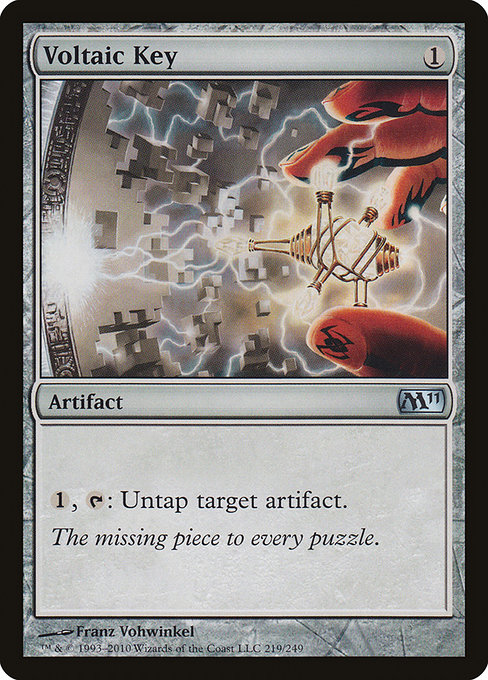
Now, thanks to untappers like
Manifold Key
Manifold Key
{1}, {T}: Untap another target artifact.
{3}, {T}: Target creature can't be blocked this turn.
,
Voltaic Key
 Voltaic Key
{1}, {T}: Untap target artifact.
, and
Tezzeret, Cruel Captain
Tezzeret, Cruel Captain
Whenever an artifact you control enters, put a loyalty counter on Tezzeret.
Voltaic Key
{1}, {T}: Untap target artifact.
, and
Tezzeret, Cruel Captain
Tezzeret, Cruel Captain
Whenever an artifact you control enters, put a loyalty counter on Tezzeret.
0: Untap target artifact or creature. If it's an artifact creature, put a +1/+1 counter on it.
−3: Search your library for an artifact card with mana value 1 or less, reveal it, put it into your hand, then shuffle.
−7: You get an emblem with "At the beginning of combat on your turn, put three +1/+1 counters on target artifact you control. If it's not a creature, it becomes a 0/0 Robot artifact creature."
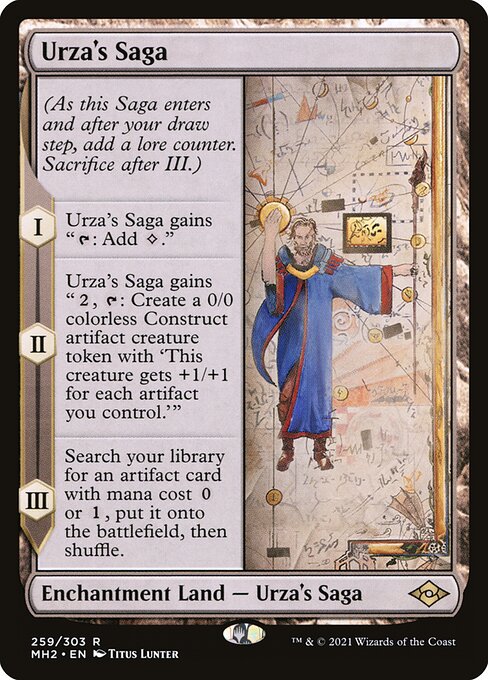
, Time Vault can untap without giving an opponent an extra turn. This easily creates a wide range of two-card infinite turn combos, many of which cost just three mana to pull off. With parts of these combos easily tutorable with cards like
Urza’s Saga
 Urza’s Saga
(As this Saga enters and after your draw step, add a lore counter. Sacrifice after III.)
Urza’s Saga
(As this Saga enters and after your draw step, add a lore counter. Sacrifice after III.)
I — This Saga gains "{T}: Add {C}."
II — This Saga gains "{2}, {T}: Create a 0/0 colorless Construct artifact creature token with 'This token gets +1/+1 for each artifact you control.'"
III — Search your library for an artifact card with mana cost {0} or {1}, put it onto the battlefield, then shuffle.
and
Tinker
Tinker
As an additional cost to cast this spell, sacrifice an artifact.
Search your library for an artifact card, put that card onto the battlefield, then shuffle.
, Time Vault is one of the most powerful things you can do in Vintage.
Outside of Vintage, where Time Vault has been restricted, this artifact is basically banned everywhere. Canadian Highlander, one of the few other places where Time Vault is playable, just underwent a massive legality change because the combo is too powerful. With all this in mind, Time Vault is easily one of the best MTG artifacts ever.
1 | Black Lotus
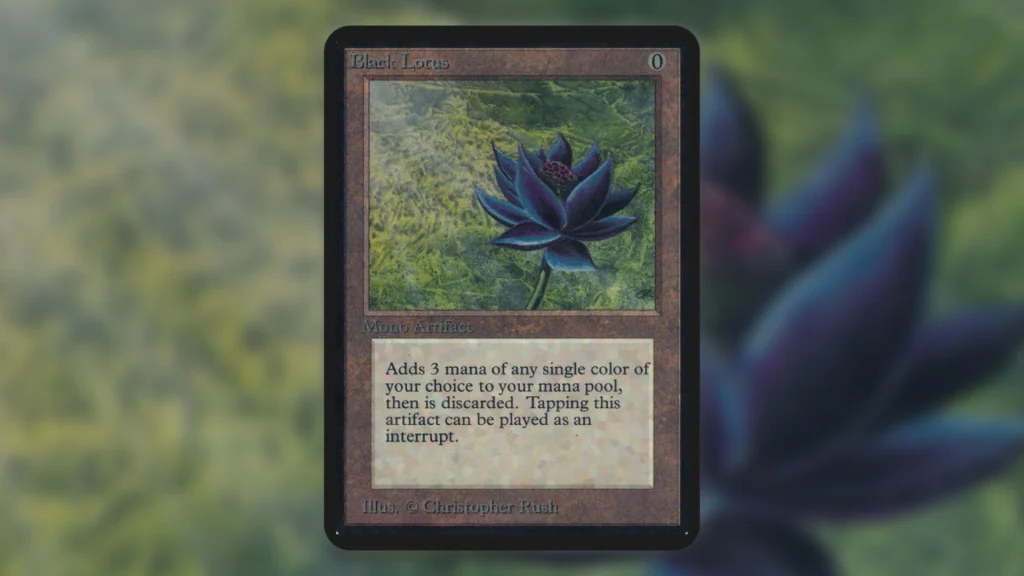
The crown jewel of the Power Nine, Black Lotus would go into each and every MTG deck if players were allowed to run it. While using four mana on turn one is always going to lead to broken starts, this artifact gets far worse when built around, potentially winning the game on turn one.
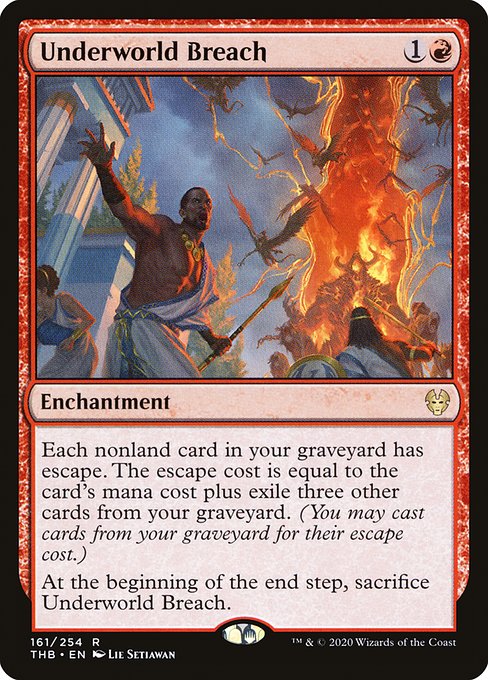
The biggest partner-in-crime for Magic’s most iconic card is
Underworld Breach
 Underworld Breach
Each nonland card in your graveyard has escape. The escape cost is equal to the card's mana cost plus exile three other cards from your graveyard. (You may cast cards from your graveyard for their escape cost.)
Underworld Breach
Each nonland card in your graveyard has escape. The escape cost is equal to the card's mana cost plus exile three other cards from your graveyard. (You may cast cards from your graveyard for their escape cost.)
At the beginning of the end step, sacrifice this enchantment.
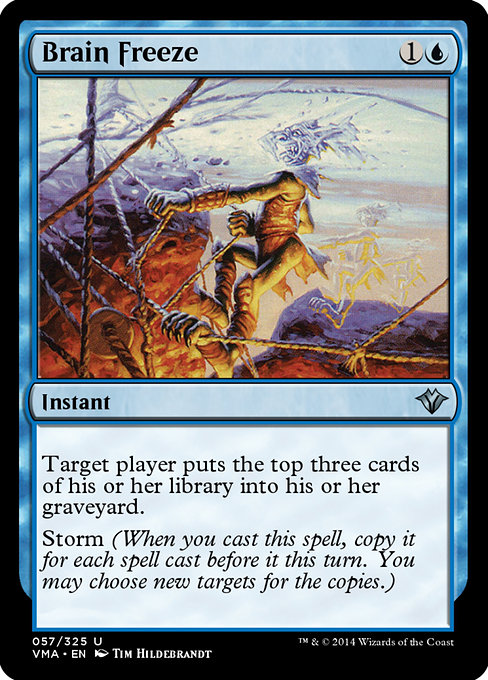
, which can abuse Black Lotus’s sacrificial condition to create endless amounts of mana. By using the card with
Brain Freeze
 Brain Freeze
Target player mills three cards.
Brain Freeze
Target player mills three cards.
Storm (When you cast this spell, copy it for each spell cast before it this turn. You may choose new targets for the copies.)
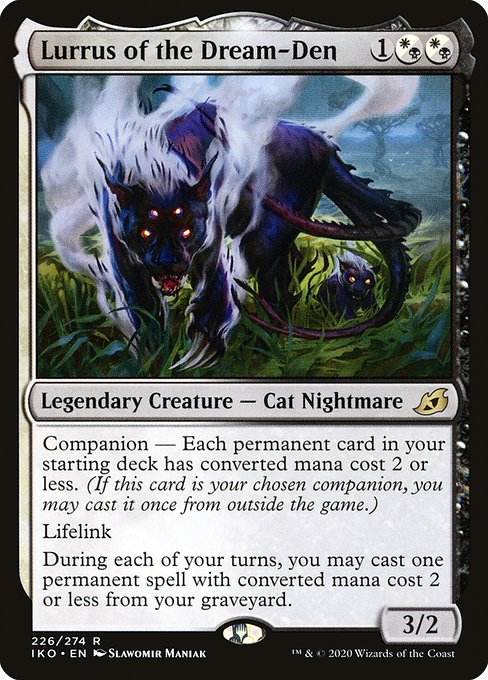
, Black Lotus can create near-infinite mana while milling out all of your opponents. Outside of comboing off, Black Lotus is also incredible with cards that can recur it, like
Lurrus of the Dream-Den
 Lurrus of the Dream-Den
Companion — Each permanent card in your starting deck has mana value 2 or less. (If this card is your chosen companion, you may put it into your hand from outside the game for {3} as a sorcery.)
Lurrus of the Dream-Den
Companion — Each permanent card in your starting deck has mana value 2 or less. (If this card is your chosen companion, you may put it into your hand from outside the game for {3} as a sorcery.)
Lifelink
Once during each of your turns, you may cast a permanent spell with mana value 2 or less from your graveyard.
.
Sadly, if you want to play Black Lotus yourself, formats that have no bans, like Vintage and Canadian Highlander, are the only places to do that. Even there, the card’s usability is extremely restricted to keep the balance of Magic’s most powerful formats in check. Considering this, Black Lotus easily fulfills its reputation as the best artifact in MTG, and arguably the best card overall.
Stick with us here at mtgrocks.com: the best site for Magic: The Gathering coverage. Be sure to check out our deckbuilder for your next big brew, and our brand new MTG Rocks Podcast!