


Though we’re now in the post-Pro Tour phase, Outlaws of Thunder Junction Standard is far from a solved format. New innovations are cropping up every few days, including a very fun take on Mono-Black Aggro at RC Montreal this past weekend. The deck made day two of the event, and brings together a ton of new cards in a shell that feels unique while still incorporating the black staples we know and love.
It’s always good to see new mechanics perform well in Magic. This deck makes a stellar showcase for Crime, a great Limited mechanic that’s now branching into constructed. If you love the sneaky, shooty side of Thunder Junction, then this may be the new deck for you. Just be sure to get your wrists ready; you’re gonna be turning a lot of cards sideways.
Read More: WOTC Solidifies Its AI Art Policy Amid Controversy!
Crime Does Pay

Let’s get into the deck. This Mono-Black Aggro list comes to us from Arun Jolly Marnier, who played it to a 7-6-0 finish at RC Montreal last weekend. Not an incredible record, but an impressive one given the deck’s novel nature. The finals of the event were dominated by the typical Esper Midrange, Azorius Control, and 4-Color Legends decks we’ve come to expect. In such a setting, even a fairly straightforward Aggro deck like this stood out.
‘Straightforward’ may be selling it short, mind you. While this is a deck that gets in early and closes out games fast, there’s also a surprising amount of nuance to it. This is mostly down to the Crime mechanic, which is really the heart of the deck, both mechanically and flavorfully. The deck plays a number of Crime payoffs, including Forsaken Miner, Vadmir, New Blood, and Kaervek, the Punisher. All three of these cards are capable of coming down early and building up serious advantage over time. Provided you can keep committing Crimes, of course.
How do you commit these Crimes? The deck has a few ways of doing so.
Tinybones Joins Up
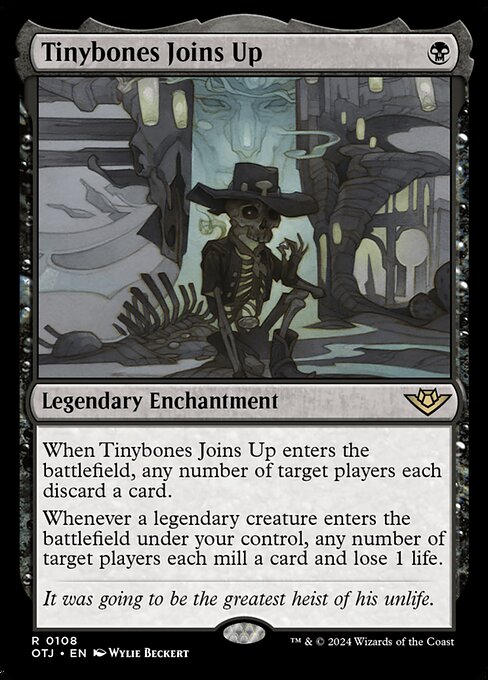 Tinybones Joins Up
When Tinybones Joins Up enters, any number of target players each discard a card.
Tinybones Joins Up
When Tinybones Joins Up enters, any number of target players each discard a card.
Whenever a legendary creature you control enters, any number of target players each mill a card and lose 1 life.
is probably the best of these, a one mana enchantment that Commits a Crime when it comes down, and can do so again each time you play a legendary creature. There are 11 legends in the deck and two in the sideboard, so this can be triggered reliably.
Beyond this, there’s the classic
Deep-Cavern Bat
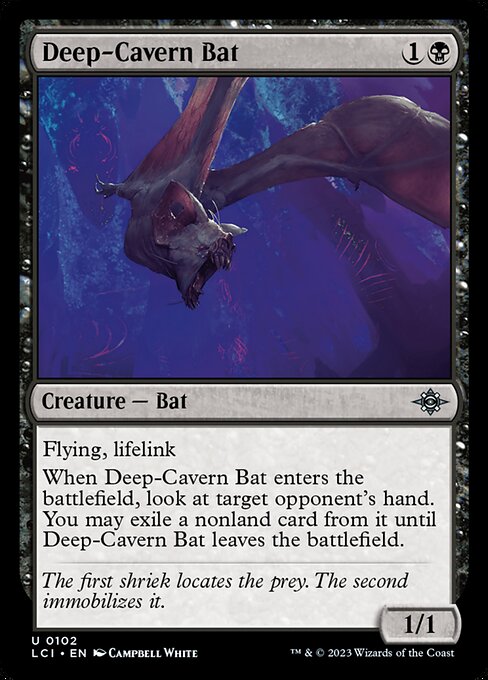 Deep-Cavern Bat
Flying, lifelink
Deep-Cavern Bat
Flying, lifelink
When this creature enters, look at target opponent's hand. You may exile a nonland card from it until this creature leaves the battlefield.
,
Gix, Yawgmoth Praetor
 Gix, Yawgmoth Praetor
Whenever a creature deals combat damage to one of your opponents, its controller may pay 1 life. If they do, they draw a card.
Gix, Yawgmoth Praetor
Whenever a creature deals combat damage to one of your opponents, its controller may pay 1 life. If they do, they draw a card.
{4}{B}{B}{B}, Discard X cards: Exile the top X cards of target opponent's library. You may play lands and cast spells from among cards exiled this way without paying their mana costs.
, and a deep black removal suite, all of which can commit more Crimes.
Read More: Underrated Thunder Junction Sorcery Has Become Multi-Format All-Star!
Spooky Scary Skeletons

So you play your Crime enablers and commit your Crimes. So far, so good. There are more layers to this lethal lasagna yet, however. There’s also a strong Skeleton sub-theme, which helps both the consistency and aggression of the deck.
We’ve already touched on Forsaken Miner, a 2/2 Skeleton for one mana that can recur via Crime triggers. Backing him up there’s
Tinybones, the Pickpocket
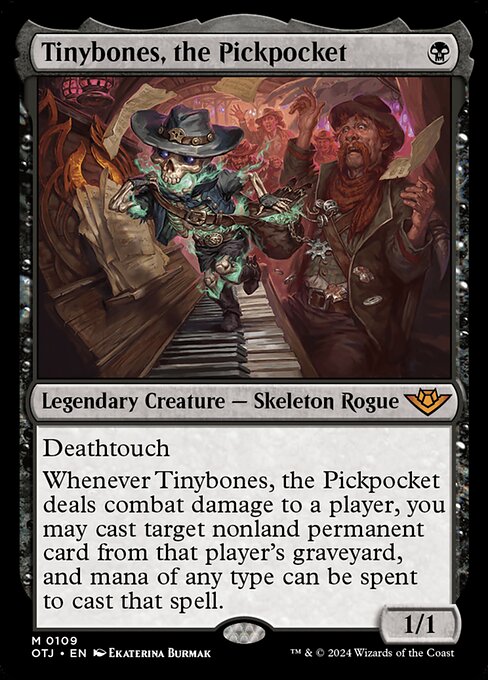 Tinybones, the Pickpocket
Deathtouch
Tinybones, the Pickpocket
Deathtouch
Whenever Tinybones deals combat damage to a player, you may cast target nonland permanent card from that player's graveyard, and mana of any type can be spent to cast that spell.
and
Case of the Stashed Skeleton
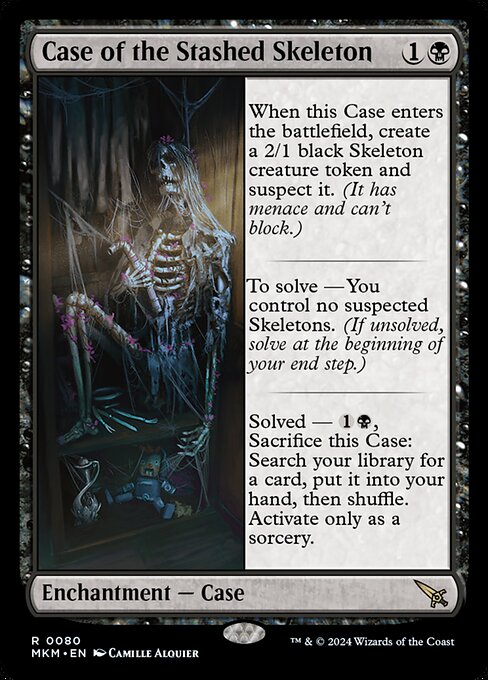 Case of the Stashed Skeleton
When this Case enters, create a 2/1 black Skeleton creature token and suspect it. (It has menace and can't block.)
Case of the Stashed Skeleton
When this Case enters, create a 2/1 black Skeleton creature token and suspect it. (It has menace and can't block.)
To solve — You control no suspected Skeletons. (If unsolved, solve at the beginning of your end step.)
Solved — {1}{B}, Sacrifice this Case: Search your library for a card, put it into your hand, then shuffle. Activate only as a sorcery.
.
Tinybones is just a great value one-drop. He trades well in the early game, then later on he can get in for damage and generate card advantage. He’s easy to chump block, but even casting one card off of him can totally swing the game. His ability also counts as committing a Crime, whether you cast the chosen card or not. Case is a 2/1 Menace Skeleton for two that becomes a
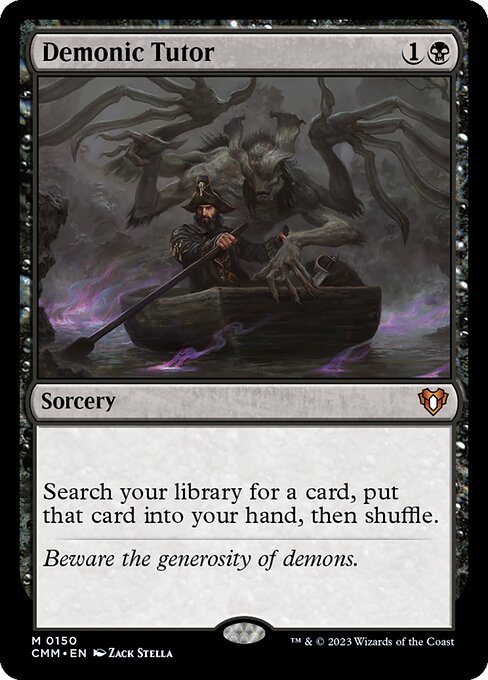
Demonic Tutor
 Demonic Tutor
Search your library for a card, put that card into your hand, then shuffle.
later, helping you grab removal or threats from your deck as needed.
Demonic Tutor
Search your library for a card, put that card into your hand, then shuffle.
later, helping you grab removal or threats from your deck as needed.
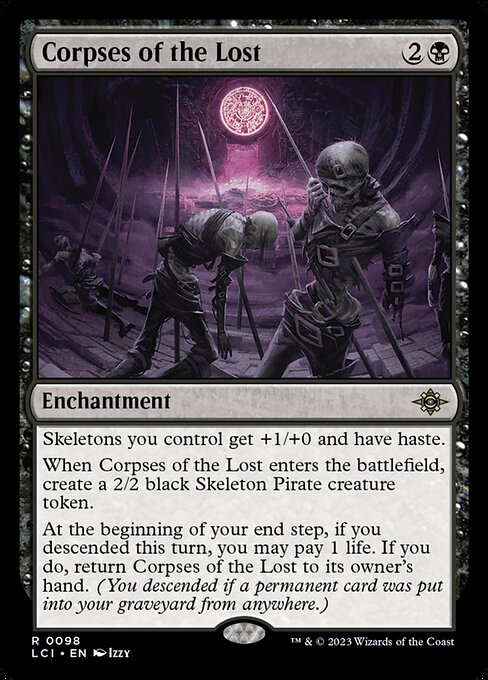
What ties this whole package together is
Corpses of the Lost
 Corpses of the Lost
Skeletons you control get +1/+0 and have haste.
Corpses of the Lost
Skeletons you control get +1/+0 and have haste.
When this enchantment enters, create a 2/2 black Skeleton Pirate creature token.
At the beginning of your end step, if you descended this turn, you may pay 1 life. If you do, return this enchantment to its owner's hand. (You descended if a permanent card was put into your graveyard from anywhere.)
. This is a three mana enchantment that gives your Skeletons +1/+0 and Haste, putting your opponent on a much quicker clock. It also comes with a Skeleton of its own. Arun’s deck plays the full four of these, going all-in on the Skelly theme. Pure Mono-Black Skeletons was a deck that was tried and quickly discarded early in the Standard season, so it’s nice to see parts of it living on in another brew.
Read More: Unassuming Thunder Junction Uncommon Could Be The Next Collected Company!
On The Side

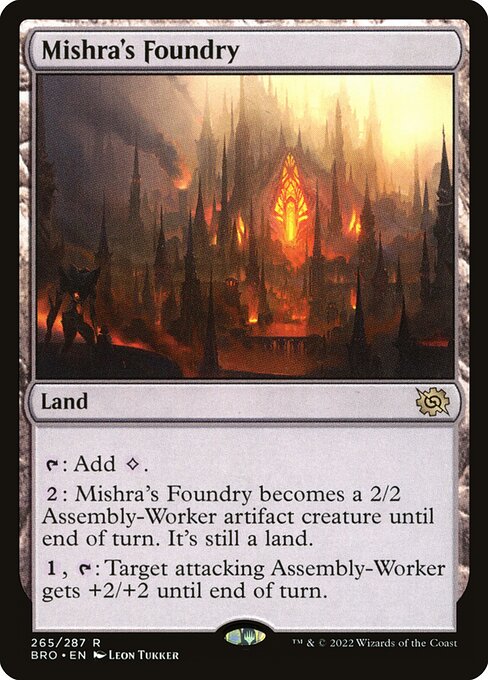
The deck mixes two powerful themes into one and runs with it, to great effect. As is typical of a Mono-Black Aggro list, or in fact any Standard Aggro list, Arun uses the mana base leniency a mono-color deck allows to tech in some powerful utility lands. Four
Mishra’s Foundry
 Mishra’s Foundry
{T}: Add {C}.
Mishra’s Foundry
{T}: Add {C}.
{2}: This land becomes a 2/2 Assembly-Worker artifact creature until end of turn. It's still a land.
{1}, {T}: Target attacking Assembly-Worker gets +2/+2 until end of turn.
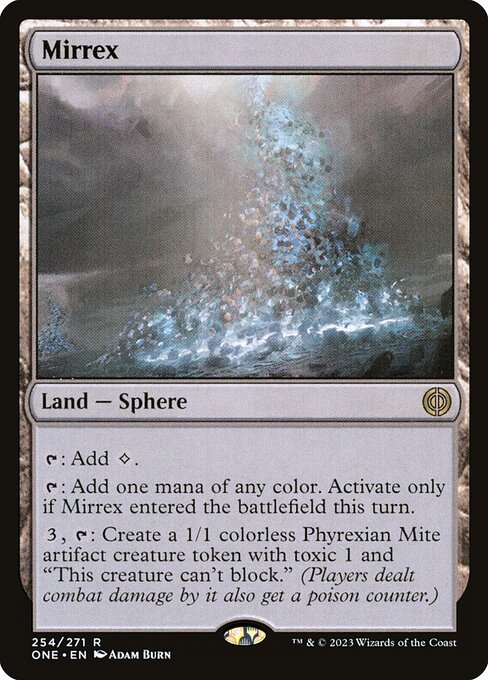
and two
Mirrex
 Mirrex
{T}: Add {C}.
Mirrex
{T}: Add {C}.
{T}: Add one mana of any color. Activate only if this land entered this turn.
{3}, {T}: Create a 1/1 colorless Phyrexian Mite artifact creature token with toxic 1 and "This token can't block." (Players dealt combat damage by it also get a poison counter.)
give some extra board presence in a pinch. Two copies of
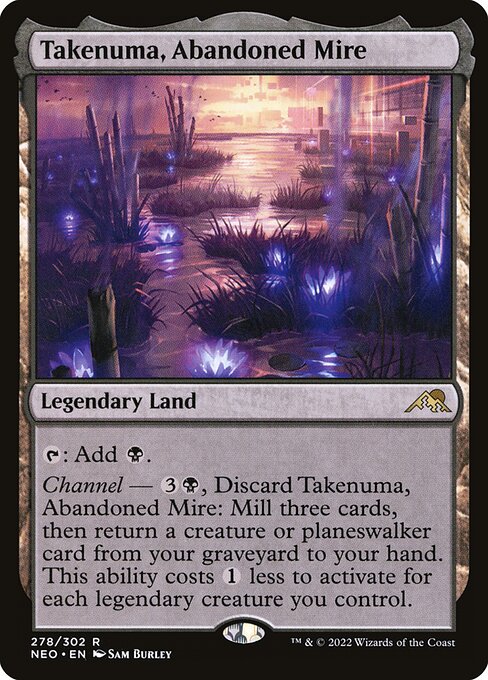
Takenuma, Abandoned Mire
 Takenuma, Abandoned Mire
{T}: Add {B}.
Takenuma, Abandoned Mire
{T}: Add {B}.
Channel — {3}{B}, Discard this card: Mill three cards, then return a creature or planeswalker card from your graveyard to your hand. This ability costs {1} less to activate for each legendary creature you control.
, on the other hand, provide a great source of card advantage. Doubly so thanks to the aforementioned 11 legendary creatures in the deck.
In the sideboard, things are much as you’d expect.
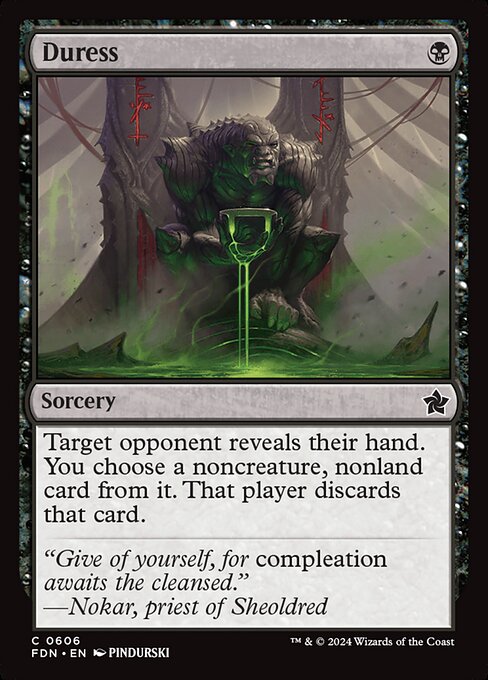
Duress
 Duress
Target opponent reveals their hand. You choose a noncreature, nonland card from it. That player discards that card.
and
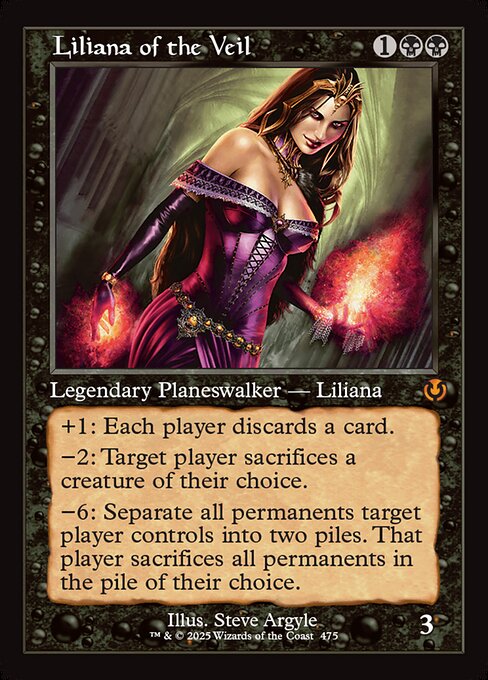
Liliana of the Veil
Duress
Target opponent reveals their hand. You choose a noncreature, nonland card from it. That player discards that card.
and
Liliana of the Veil
 Liliana of the Veil
+1: Each player discards a card.
Liliana of the Veil
+1: Each player discards a card.
−2: Target player sacrifices a creature.
−6: Separate all permanents target player controls into two piles. That player sacrifices all permanents in the pile of their choice.
provide some hand attack against Combo and Control decks.
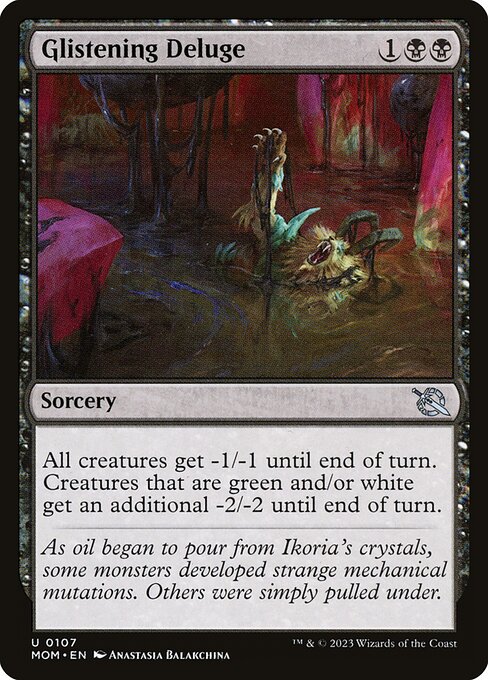
Glistening Deluge
 Glistening Deluge
All creatures get -1/-1 until end of turn. Creatures that are green and/or white get an additional -2/-2 until end of turn.
ruins Boros Convoke’s day.
Sheoldred, the Apocalypse
Glistening Deluge
All creatures get -1/-1 until end of turn. Creatures that are green and/or white get an additional -2/-2 until end of turn.
ruins Boros Convoke’s day.
Sheoldred, the Apocalypse
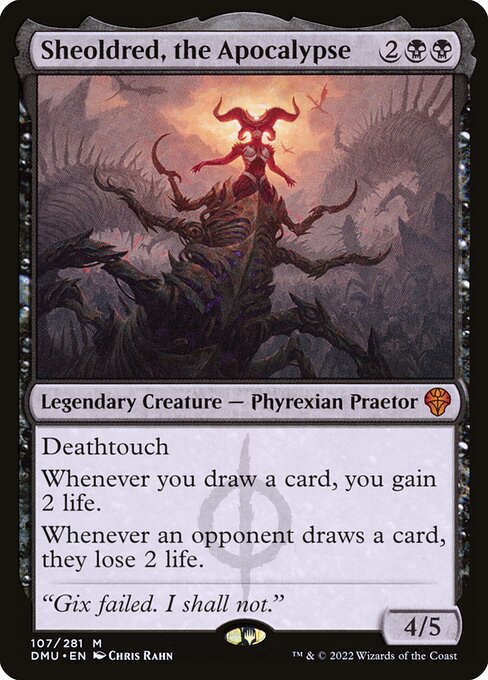 Sheoldred, the Apocalypse
Deathtouch
Sheoldred, the Apocalypse
Deathtouch
Whenever you draw a card, you gain 2 life.
Whenever an opponent draws a card, they lose 2 life.
shows up as a two-of, to raise your ceiling in Control and Midrange matchups.
The best card in the ‘board, and one that could be a real contender for main deck inclusion, is
Unlicensed Hearse
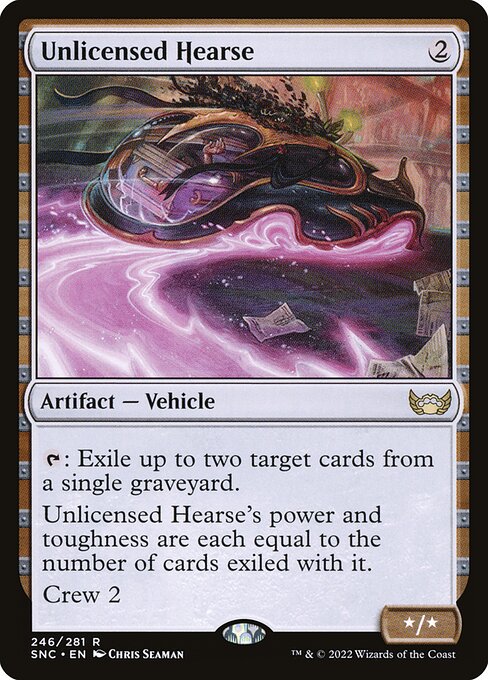 Unlicensed Hearse
{T}: Exile up to two target cards from a single graveyard.
Unlicensed Hearse
{T}: Exile up to two target cards from a single graveyard.
Unlicensed Hearse's power and toughness are each equal to the number of cards exiled with it.
Crew 2
. Not only is this repeatable graveyard hate against Analyst decks, be they Temur or Jund, but it’s also an easy way to commit Crimes every turn. The fact that it’s also an easily-Crewed scaling threat is almost secondary to these other aspects, but worth bearing in mind regardless.
Crafty Counters

So that’s the deck, but what can you do if you come face to face with it yourself? It may not be meta yet, but that could well change following RC Montreal, and it’s best to be prepared just in case.
Looking at Arun’s performance with the deck at the RC, a lot of matchups are fairly even. Esper Midrange and Domain Ramp/Control, to name a few. The deck also matches up favorably against Golgari Midrange and Orzhov Bronco, thanks to its overwhelming aggression. Where the deck falls apart is against Temur Analyst and Mono-Red Aggro.
In the case of the former, Analyst attacks on an axis that the deck simply isn’t prepared to fight on game one. Even post-sideboard, once the Unlicensed Hearses come in, the deck still has few tools to combat the Analyst game plan. Analyst also plays plenty of Artifact hate out of the sideboard, so hitting you Hearse is no guarantee of success.
Mono-Red, on the other hand, is simply faster. With the advent of
Slickshot Show-Off
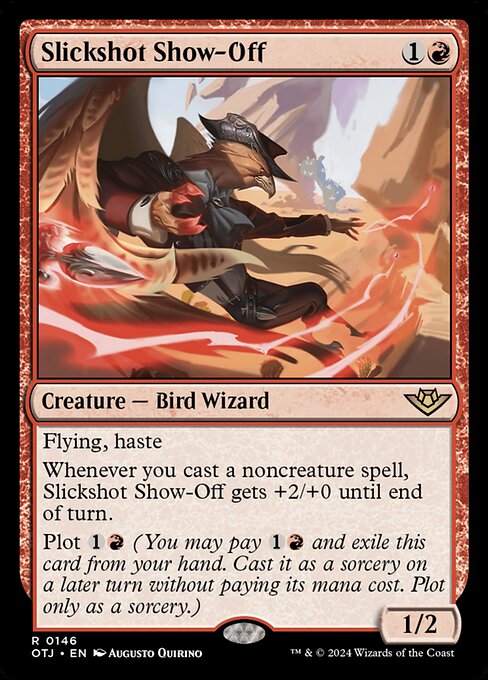 Slickshot Show-Off
Flying, haste
Slickshot Show-Off
Flying, haste
Whenever you cast a noncreature spell, this creature gets +2/+0 until end of turn.
Plot {1}{R} (You may pay {1}{R} and exile this card from your hand. Cast it as a sorcery on a later turn without paying its mana cost. Plot only as a sorcery.)
, the deck can kill out of nowhere as early as turn three. If you don’t draw your Deep-Cavern Bat to intercept, or some removal, that’s game over. If you can stabilize early the Mono-Red matchup is winnable, as Arun proved by going 1-2 against the deck, but it’s an uphill struggle.
Overall, the deck looks great, and Arun had a solid run with it at RC Montreal. It may not have topped the event, but watch this space. Mono-Black is an archetype that’s only going to get better as lists are refined, and both Crime and Skeletons are deep wells to draw from.
Read More: Underrated MTG Hydra Helps Unique Gruul Counters Shell Flourish!