


Since Alpha, cards like
Lord of Atlantis
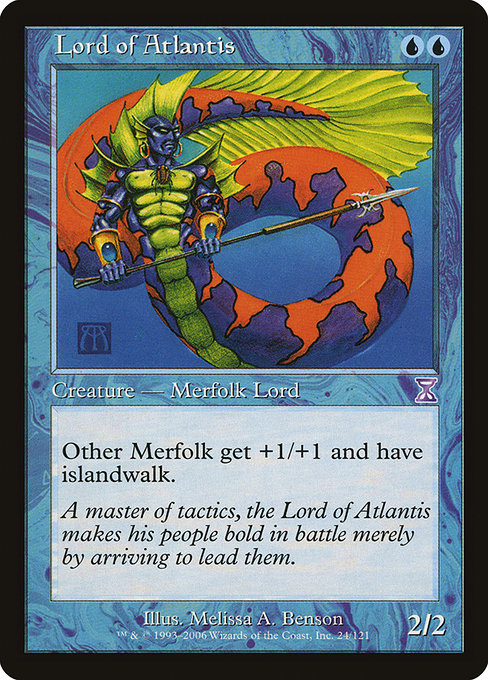 Lord of Atlantis
Other Merfolk get +1/+1 and have islandwalk. (They can't be blocked as long as defending player controls an Island.)
and
Goblin King
Lord of Atlantis
Other Merfolk get +1/+1 and have islandwalk. (They can't be blocked as long as defending player controls an Island.)
and
Goblin King
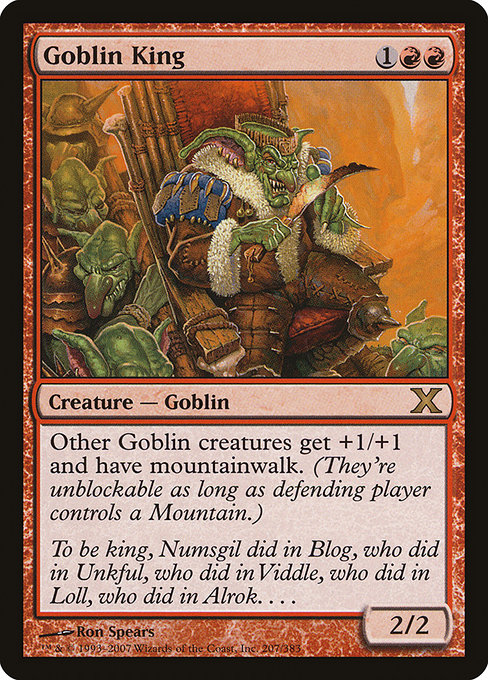 Goblin King
Other Goblins get +1/+1 and have mountainwalk.
have meant creature types always mattered in Magic. That said, over the years, a growing number of creatures have broken this concept thanks to the Changeling ability. Additionally, there are plenty of cards with synergistic abilities such as
Maskwood Nexus
Goblin King
Other Goblins get +1/+1 and have mountainwalk.
have meant creature types always mattered in Magic. That said, over the years, a growing number of creatures have broken this concept thanks to the Changeling ability. Additionally, there are plenty of cards with synergistic abilities such as
Maskwood Nexus
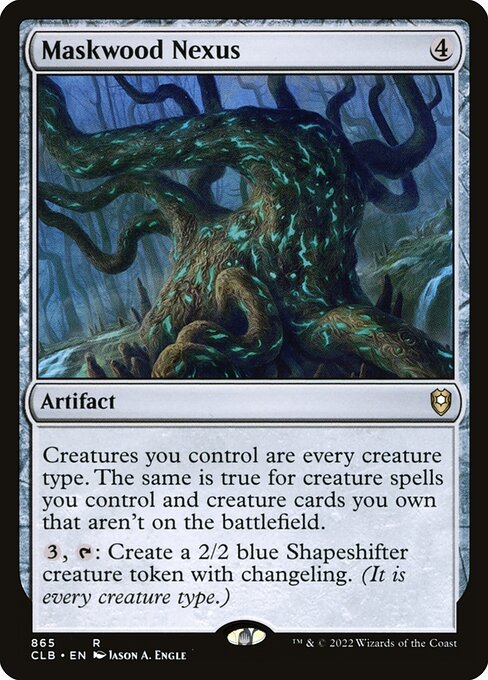 Maskwood Nexus
Creatures you control are every creature type. The same is true for creature spells you control and creature cards you own that aren't on the battlefield.
Maskwood Nexus
Creatures you control are every creature type. The same is true for creature spells you control and creature cards you own that aren't on the battlefield.
{3}, {T}: Create a 2/2 blue Shapeshifter creature token with changeling. (It is every creature type.)
or even five type
Burakos, Party Leader
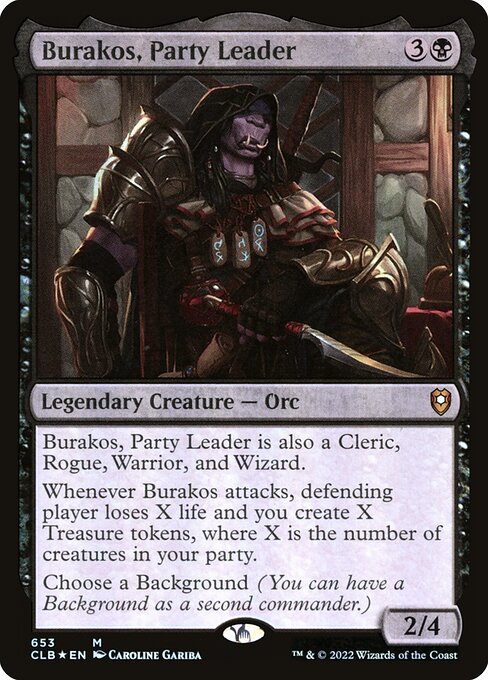 Burakos, Party Leader
Burakos is also a Cleric, Rogue, Warrior, and Wizard.
Burakos, Party Leader
Burakos is also a Cleric, Rogue, Warrior, and Wizard.
Whenever Burakos attacks, defending player loses X life and you create X Treasure tokens, where X is the number of creatures in your party.
Choose a Background (You can have a Background as a second commander.)
among others. All told, you have easily over 40 Changeling creatures and dozens more highly synergistic cards that can give you a huge start on any type, ever.
What does this mean? It means that one, uniform, stack of cards is a Bear deck, a Druid deck, a Saproling deck, a Soldier deck and so on. Furthermore, while there are many Changelings that have no other abilities, some of them do and are useful in many typal decks. With the critical mass of an all-types deck having been broken some time ago, we are moving further into uncharted waters courtesy of multiple unique cards. What does the future hold for types in Magic and are the designs new, compelling and on the right track?
The Distant Past
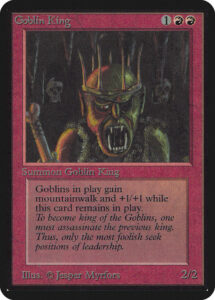
This is an Alpha print
Goblin King
Goblin King
Other Goblins get +1/+1 and have mountainwalk.
. It’s very clearly a Goblin right? It reads that “Goblins in play gain mountainwalk and +1/+1” so clearly it gets its own buff, right? Well, no, technically it was a “Goblin King” which is not a “Goblin”. While this was the intended effect, that the card not receive its own buff, it was pretty poorly executed. Look at another attempt a few years later to clear up the confusion.
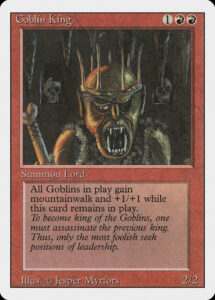
This Revised edition King shows the type changes made as Magic slightly altered the card. No longer a Goblin, the King was merely a Lord and nothing else. This is how the game was until…
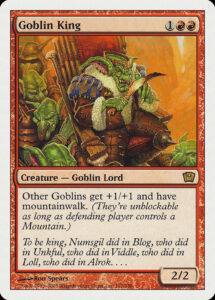
So yes, it only made sense that Goblin King would be an actual Goblin, and if you wanted it to not buff itself you merely had to write “other Goblins” for that to happen. Yes, it took them years to make this change but it was the start. Mirrodin was where they focused on the class/type format as the new way forward.
Another huge event called “The Grand Creature Type Update” in 2007 sought to fix all the past weird creature types, corner cases, and other rules associated with creatures of a typal nature. Gone were the days of “Summon
Uncle Istvan
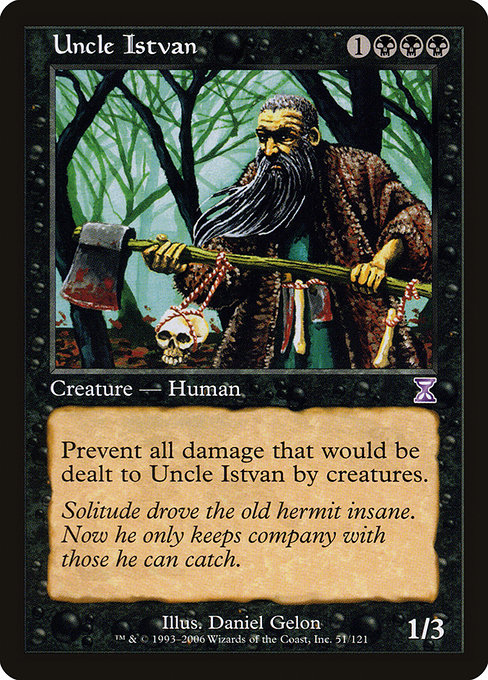 Uncle Istvan
Prevent all damage that would be dealt to this creature by creatures.
” in were the days of “Human Soldier” and for a long time it was good. The type update was essentially a necessary part of the Lorwyn block to clear up confusion going forward as they introduced “Tribal” and “Changeling” keywords. Cards became relatively uniform and effects were streamlined and consistent. Magic has always had Elf decks and Goblin decks and Merfolk decks but the card support was not always equally distributed or mechanically deep in each case. Soon that would change.
Uncle Istvan
Prevent all damage that would be dealt to this creature by creatures.
” in were the days of “Human Soldier” and for a long time it was good. The type update was essentially a necessary part of the Lorwyn block to clear up confusion going forward as they introduced “Tribal” and “Changeling” keywords. Cards became relatively uniform and effects were streamlined and consistent. Magic has always had Elf decks and Goblin decks and Merfolk decks but the card support was not always equally distributed or mechanically deep in each case. Soon that would change.
Read More: Dimir is Completely Dominating this MTG Format!
But Then Commander Happened
Commander can trace its original roots to “EDH” back as far as 1996, and regardless of the exact born on date it’s an old format. Second only to the original Elder Dragon based decks would be “theme” decks, whether typal based, mechanic-centric like milling or even artist focused.

It did not happen all at once but, gradually, Wizards has been making much more compelling and interesting choices when it comes down to type based decks. Cards like
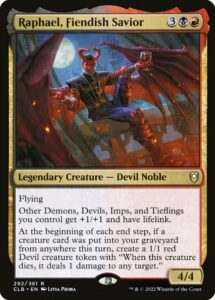
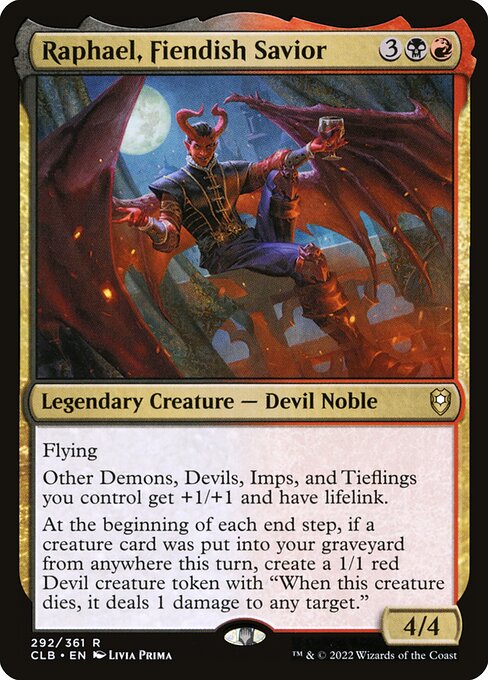
Raphael, Fiendish Savior
 Raphael, Fiendish Savior
Flying
Raphael, Fiendish Savior
Flying
Other Demons, Devils, Imps, and Tieflings you control get +1/+1 and have lifelink.
At the beginning of each end step, if a creature card was put into your graveyard from anywhere this turn, create a 1/1 red Devil creature token with "When this token dies, it deals 1 damage to any target."
understand that there are broader themes than just having the Devil type. Oftentimes you will want a mix of Demons and Imps from throughout Magic’s history for both flavor and power reasons. But Raphael also includes the various Dungeons and Dragons sets which have added Tieflings for additional, new variety. Any card that is trying to work in a typal nature generally needs to accept that Magic has a vast card pool over 30 years old. If it does not it will end up as a far more limited and stale card. Speaking of vast interaction…
This is Where we were Heading
Morophon, the Boundless
 Morophon, the Boundless
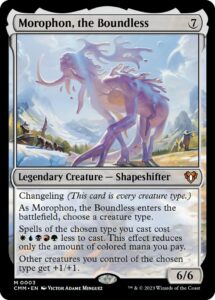
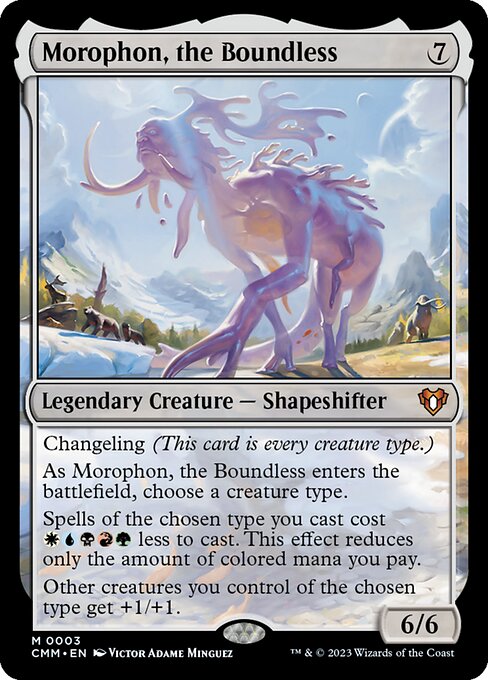
Changeling (This card is every creature type.)
Morophon, the Boundless
Changeling (This card is every creature type.)
As Morophon enters, choose a creature type.
Spells of the chosen type you cast cost {W}{U}{B}{R}{G} less to cast. This effect reduces only the amount of colored mana you pay.
Other creatures you control of the chosen type get +1/+1.
is an awesome card, terrifyingly awesome in fact. Because it is every creature type, it allows you to easily select it as a commander for every existing creature type in Magic now… but also in the future as well. That’s the problem. If Magic makes a new creature type, you already have a very compelling choice for your commander in Morophon. Furthermore, the minimum viable product must be at least as good as Morophon or you might as well play Morophon, right? With a template of Morophon and forty other Changelings, you have a minimum threshold that every printed card must cross not only for power but also simple functionality. It’s one thing to compare
Grizzly Bears
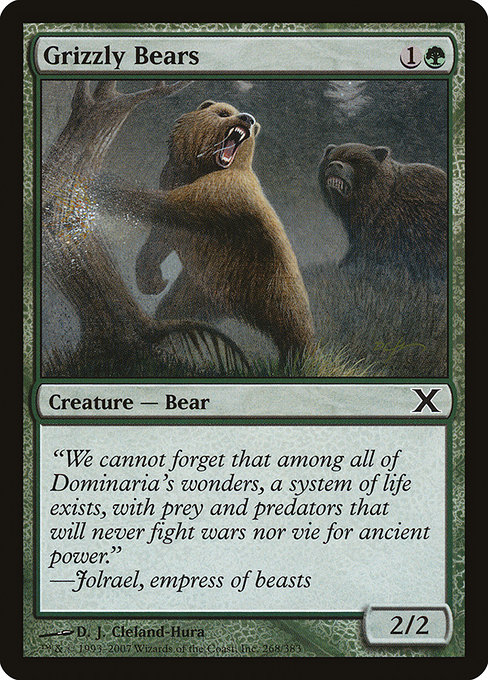 Grizzly Bears
to
Elvish Archers
Grizzly Bears
to
Elvish Archers
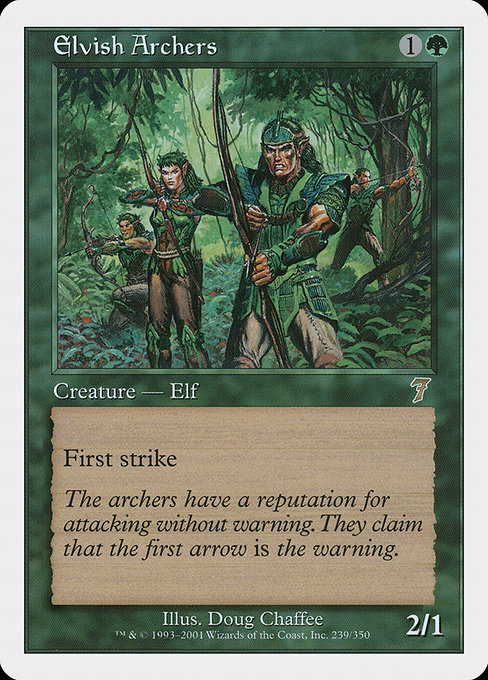 Elvish Archers
First strike
in a vacuum, but quite another to compare them across types. What good is an Elf in a Bear deck and vice versa? They do different things for different decks and are not directly comparable in many cases. However, cards like Morophon can, in some cases, remove player agency and reduce deck building choices if they are purely superior to anything else available. It’s a tough line to walk between having that extra functionality like Raphael has to being something that potentially crowds out other cards like Morophon. But there are several signs that Wizards is starting to see how much more types matter to the future of Magic design.
Elvish Archers
First strike
in a vacuum, but quite another to compare them across types. What good is an Elf in a Bear deck and vice versa? They do different things for different decks and are not directly comparable in many cases. However, cards like Morophon can, in some cases, remove player agency and reduce deck building choices if they are purely superior to anything else available. It’s a tough line to walk between having that extra functionality like Raphael has to being something that potentially crowds out other cards like Morophon. But there are several signs that Wizards is starting to see how much more types matter to the future of Magic design.
Read More: New MTG Leaks Reveal Concerning Standard Staples
Wizards has been Doing Their Homework
Embiggen
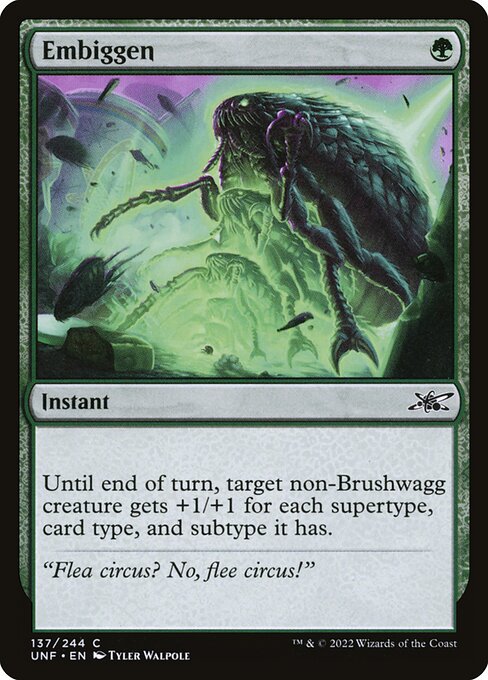 Embiggen
Until end of turn, target non-Brushwagg creature gets +1/+1 for each supertype, card type, and subtype it has.
made waves as a strictly superior
Giant Growth
Embiggen
Until end of turn, target non-Brushwagg creature gets +1/+1 for each supertype, card type, and subtype it has.
made waves as a strictly superior
Giant Growth
 Giant Growth
Target creature gets +3/+3 until end of turn.
effect in an infect based deck as long as a creature has enough types. Of course, right away, you can see that Changelings cannot be targeted by this effect because they are also Brushwaggs (they know what they did). This card had players scrambling to take a look at type lines in search of interaction. That is the key. Mechanics that allow players to make interesting deck building decisions that don’t have purely formulaic solutions are popping up more and more.
Giant Growth
Target creature gets +3/+3 until end of turn.
effect in an infect based deck as long as a creature has enough types. Of course, right away, you can see that Changelings cannot be targeted by this effect because they are also Brushwaggs (they know what they did). This card had players scrambling to take a look at type lines in search of interaction. That is the key. Mechanics that allow players to make interesting deck building decisions that don’t have purely formulaic solutions are popping up more and more.
Right now Rukumarel, Biologist is not seeing huge play, but this card is an excellent sign for the future. As a five color commander that remixes your creatures into Slivers, the upper limit of this card is massive. One of the strongest potential cards to join Rukumarel is undoubtedly
Hatchery Sliver
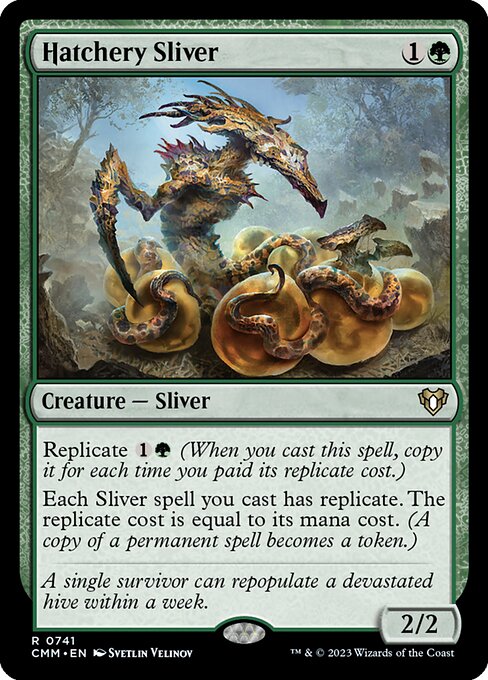 Hatchery Sliver
Replicate {1}{G} (When you cast this spell, copy it for each time you paid its replicate cost.)
Hatchery Sliver
Replicate {1}{G} (When you cast this spell, copy it for each time you paid its replicate cost.)
Each Sliver spell you cast has replicate. The replicate cost is equal to its mana cost. (A copy of a permanent spell becomes a token.)
. It doesn’t take long to think about naming Thopter and replicating an infinite number of
Ornithopter
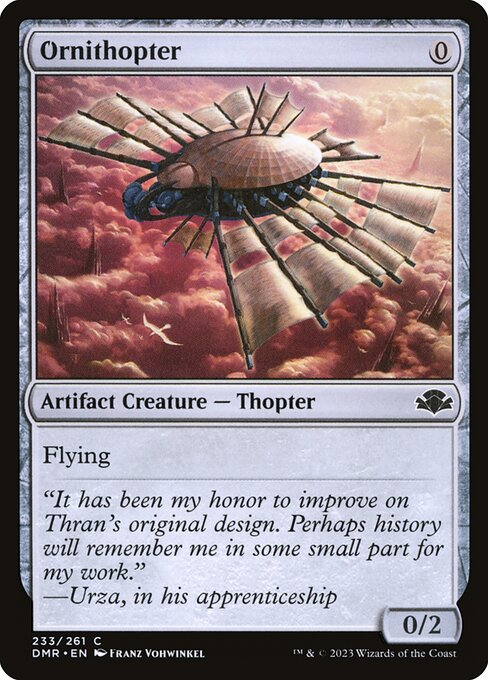 Ornithopter
Flying
with any kind of wincon like
Impact Tremors
Ornithopter
Flying
with any kind of wincon like
Impact Tremors
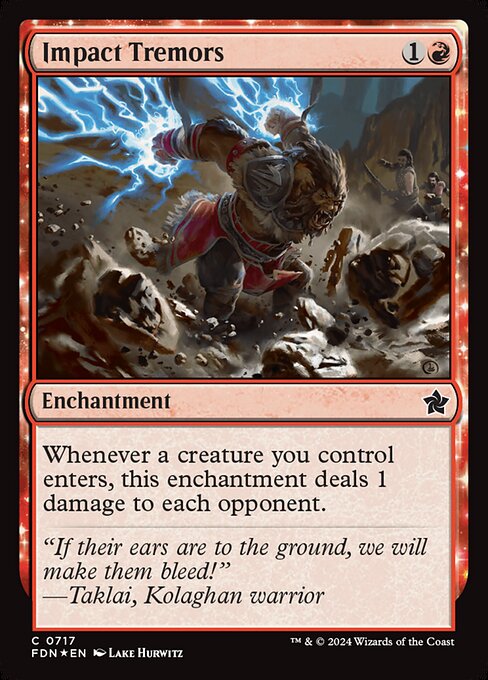 Impact Tremors
Whenever a creature you control enters, this enchantment deals 1 damage to each opponent.
. Sure, that’s not an optimal combo as it’s four cards but it’s an example that in a five color deck the potential is limitless. Merely making a single extra copy of something good can often be a game winning move and using flicker effects like
Displacer Kitten
Impact Tremors
Whenever a creature you control enters, this enchantment deals 1 damage to each opponent.
. Sure, that’s not an optimal combo as it’s four cards but it’s an example that in a five color deck the potential is limitless. Merely making a single extra copy of something good can often be a game winning move and using flicker effects like
Displacer Kitten
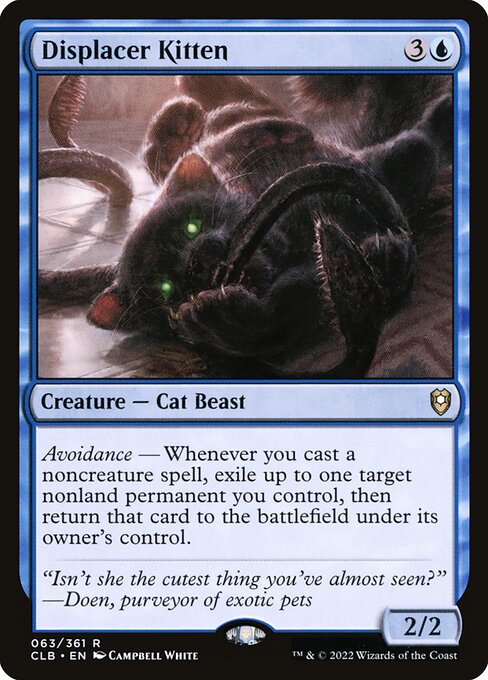 Displacer Kitten
Avoidance — Whenever you cast a noncreature spell, exile up to one target nonland permanent you control, then return that card to the battlefield under its owner's control.
can make creative players choose a new creature type every single spell. Rukumarel makes you really look at a combination of Slivers, other creature types and effects to make a deck that is greater than a pile of creatures of the same (or all) types.
Displacer Kitten
Avoidance — Whenever you cast a noncreature spell, exile up to one target nonland permanent you control, then return that card to the battlefield under its owner's control.
can make creative players choose a new creature type every single spell. Rukumarel makes you really look at a combination of Slivers, other creature types and effects to make a deck that is greater than a pile of creatures of the same (or all) types.
Finally another, future, example is the new Doctor Who set’s Doctor’s Companion keyword. The way the mechanic works is just a bit different than the Partner mechanic, or the Friends Forever mechanic. Evidently it’s type based but with a twist as you can read from Gavin Verhey’s post here. You must be any Time Lord Doctor with a Doctor’s Companion keyword to use them both as commanders, but the Time Lord Doctor cannot have any other types. This allows the set companions to be mixed with all the different doctors so that there is a much larger amount of potential combinations than Partner With which thematically follows for Doctor Who. Wizards clearly wanted to showcase that specific types mattered and they were willing to make up a new mechanic unique to this set alone.
Read More: Everything We Know About The Lost Caverns of Ixalan MTG Set
A Bright Future, a Fine Line
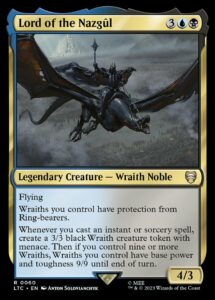
A fairly popular new commander from Lord of the Rings
Lord of the Nazgul
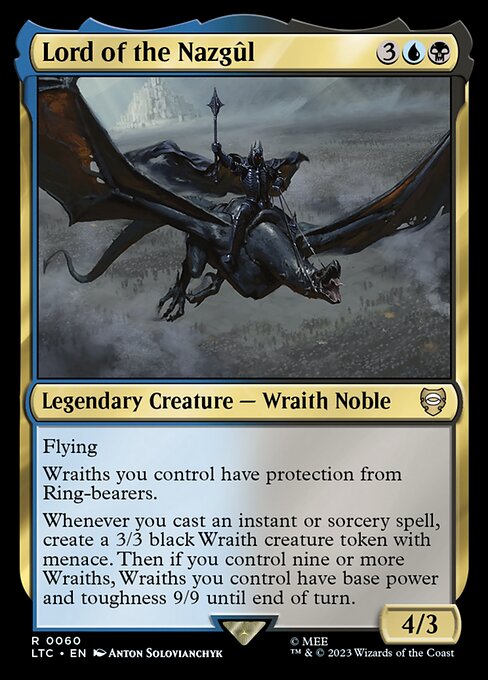 Lord of the Nazgul
Flying
Lord of the Nazgul
Flying
Wraiths you control have protection from Ring-bearers.
Whenever you cast an instant or sorcery spell, create a 3/3 black Wraith creature token with menace. Then if you control nine or more Wraiths, Wraiths you control have base power and toughness 9/9 until end of turn.
received a lot of help from the set itself. With the ability to run up to nine
Nazgul
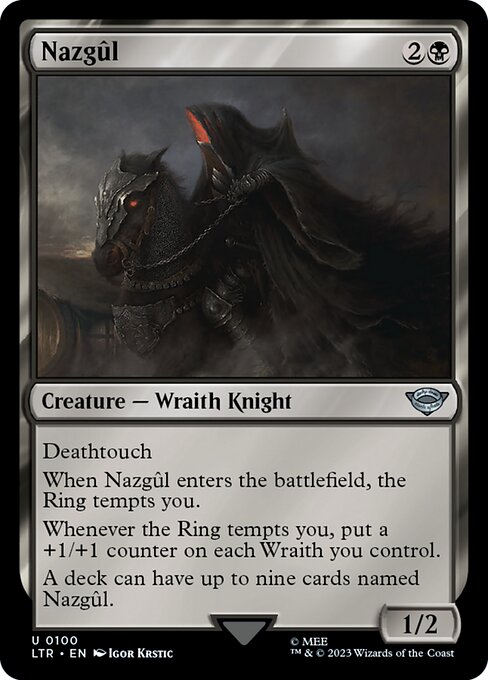 Nazgul
Deathtouch
Nazgul
Deathtouch
When this creature enters, the Ring tempts you.
Whenever the Ring tempts you, put a +1/+1 counter on each Wraith you control.
A deck can have up to nine cards named Nazgûl.
you see every deck submitted to EDHREC has chosen to do so, and why wouldn’t you? It’s thematic and powerful at the same time and there are a lot of new Wraiths in the set. However 35% of decks, a fairly high amount, are running
Changeling Outcast
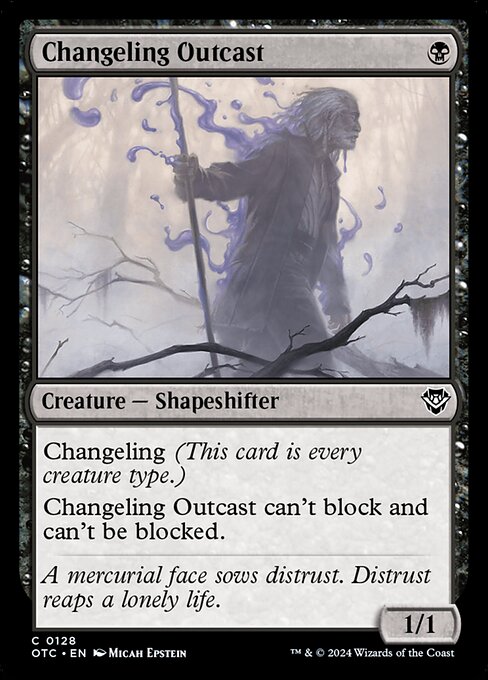 Changeling Outcast
Changeling (This card is every creature type.)
Changeling Outcast
Changeling (This card is every creature type.)
This creature can't block and can't be blocked.
to up your Wraith count alongside other changelings.
This deck itself walks this fine line of only really including enough extra “Wraiths” with decent enough abilities, via Changelings, to give the deck critical mass without relying on the same few cards that could go into many decks. Of course, Wizards did their part making sure that there were enough building blocks to not be forced to include too many non-thematic cards purely on a numbers level. More and more cards are being printed where type is an ability worth talking about as well as plenty of newer cards featuring three types as a new gold standard instead of two. Just don’t bring up
Baral and Kari Zev
 Baral and Kari Zev
First strike, menace
Baral and Kari Zev
First strike, menace
Whenever you cast your first instant or sorcery spell each turn, you may cast a spell with lesser mana value that shares a card type with it from your hand without paying its mana cost. If you don't, create First Mate Ragavan, a legendary 2/1 red Monkey Pirate creature token. It gains haste until end of turn.
as it’s obviously a misprint, right Wizards?
Read More: Wizards of the Coast Suggests Potential for Further MTG Unbannings!