


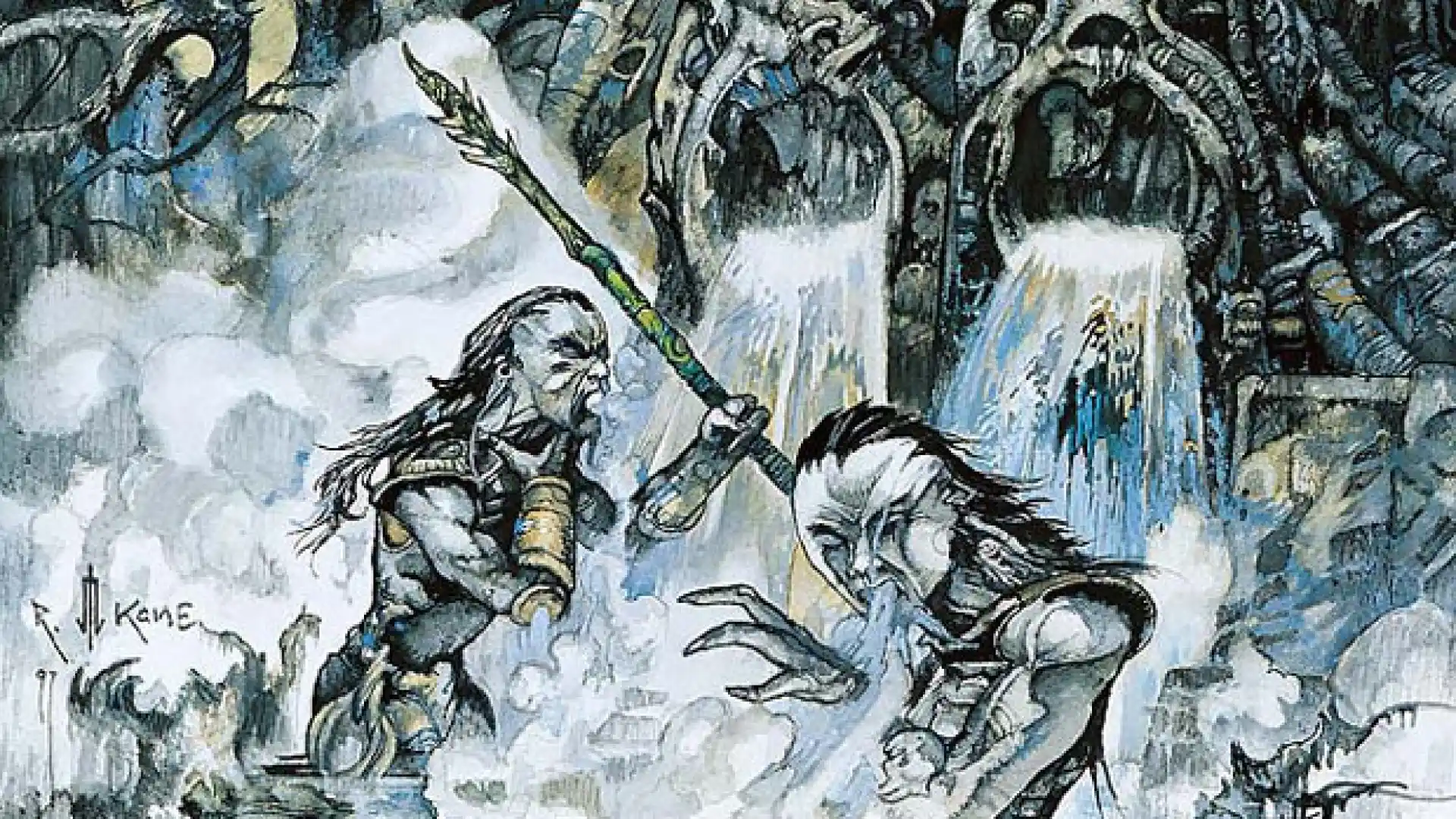

While most strategies are viable to a degree in Magic’s Commander format, some are definitely better suited to it than others. Burn, for example, struggles against the hugely inflated Commander life totals, where you need to deal 120 damage instead of 20 to close the game.
That said, some Burn tools do scale quite nicely in the format, including MTG classic Price of Progress. With nonbasic lands entering Magic at a record rate, players are waking up to how good this instant is in Commander.
Price of Progress MTG
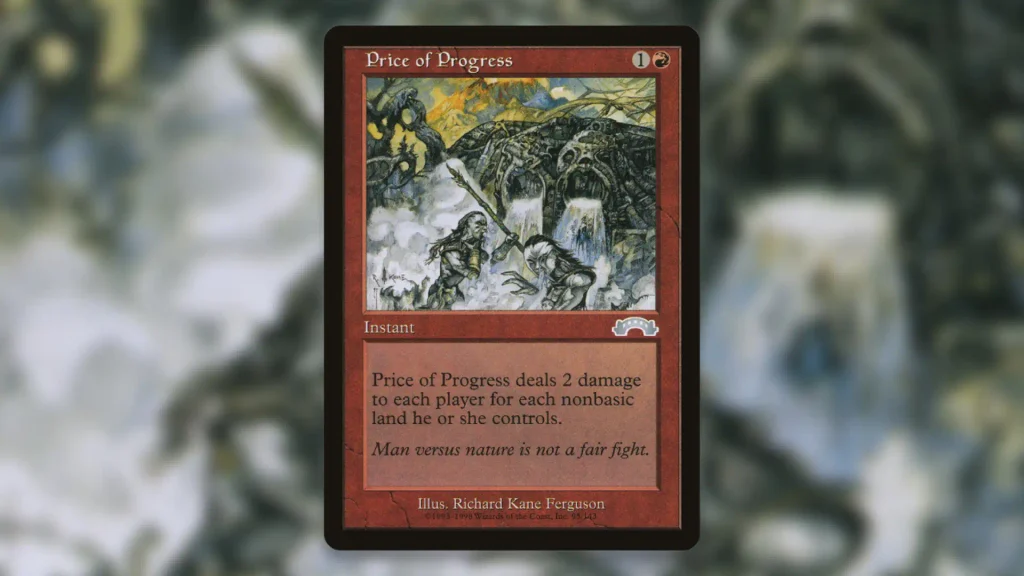
Price of Progress has been in the press a ton this week, with content creators like MTG Goldfish and Ben Bateman choosing to spotlight the card in new videos. Given how powerful its effect is, that’s not hugely surprising.
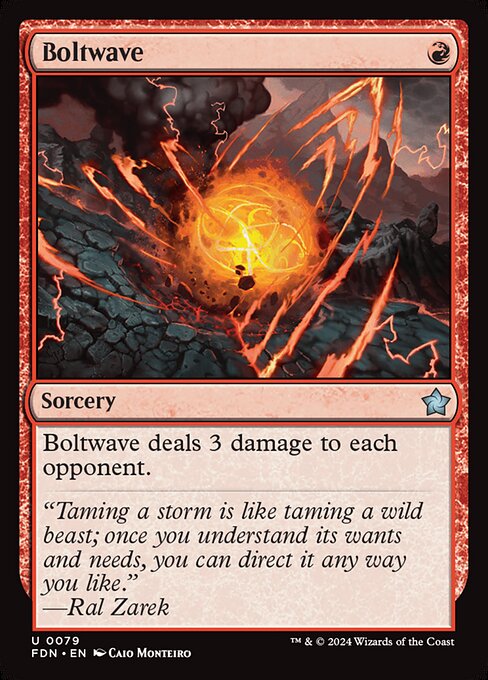
Price of Progress lets you burn everyone at the table for two damage for each nonbasic land they control, which can easily be 10-20 life each in most games. With most single-use burn in the format sitting closer to
Boltwave
 Boltwave
 deals 3 damage to each opponent.
in terms of damage potential, this represents a big spike in power.
Boltwave
Boltwave deals 3 damage to each opponent.
in terms of damage potential, this represents a big spike in power.
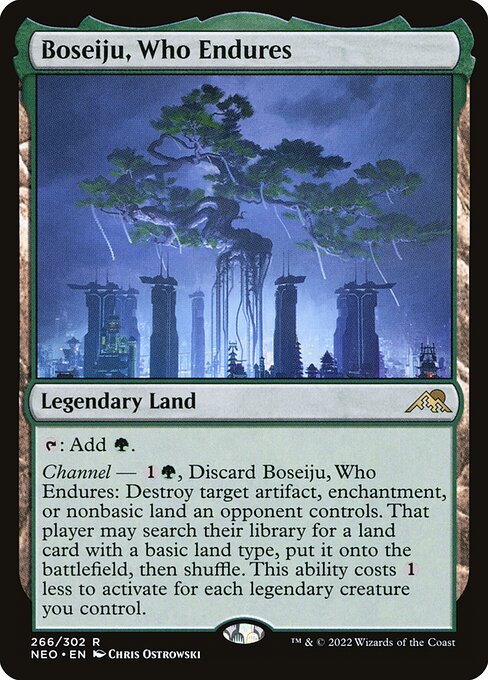
This is largely down to the way mana bases are built in Commander these days. Where it was once common to run 10 or more basic lands in any given deck, the huge rise in playable utility lands has largely pushed them out of the format. Why run a Forest when you could run
Boseiju, Who Endures
 Boseiju, Who Endures
{T}: Add {G}.
Boseiju, Who Endures
{T}: Add {G}.
Channel — {1}{G}, Discard this card: Destroy target artifact, enchantment, or nonbasic land an opponent controls. That player may search their library for a land card with a basic land type, put it onto the battlefield, then shuffle. This ability costs {1} less to activate for each legendary creature you control.
, for example, or an Island when you could run
Mistrise Village
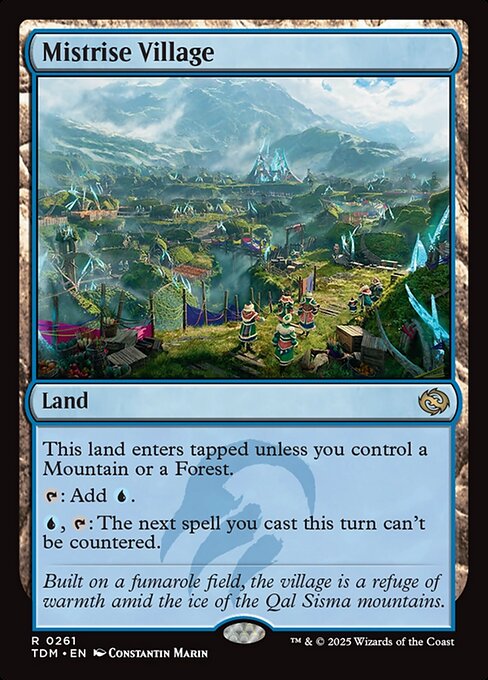 Mistrise Village
This land enters tapped unless you control a Mountain or a Forest.
Mistrise Village
This land enters tapped unless you control a Mountain or a Forest.
{T}: Add {U}.
{U}, {T}: The next spell you cast this turn can't be countered.
. With better dual land cycles like the Verge lands available, too, basics are now an afterthought for the majority of non-budget lists.
Because of this, Price of Progress can reliably dome the whole pod for double-digit damage, which can be enough to finish things off in Aggro or Burn lists. You can also turn it into a win condition in its own right by pairing it with damage multipliers like
Fiery Emancipation
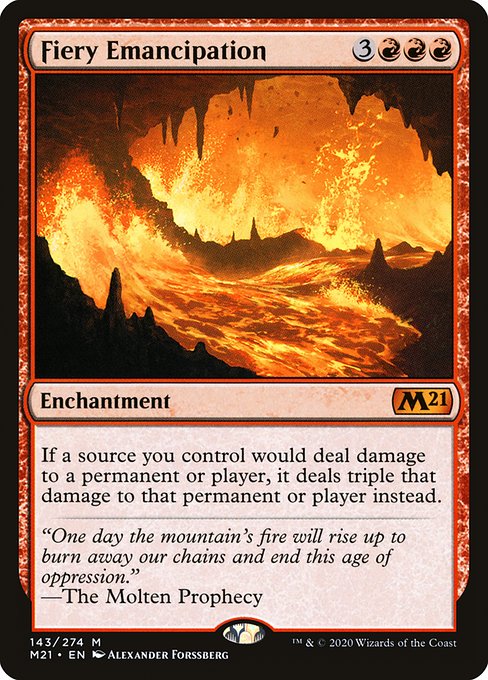 Fiery Emancipation
If a source you control would deal damage to a permanent or player, it deals triple that damage to that permanent or player instead.
, or casting it repeatedly by Imprinting it on
Isochron Scepter
Fiery Emancipation
If a source you control would deal damage to a permanent or player, it deals triple that damage to that permanent or player instead.
, or casting it repeatedly by Imprinting it on
Isochron Scepter
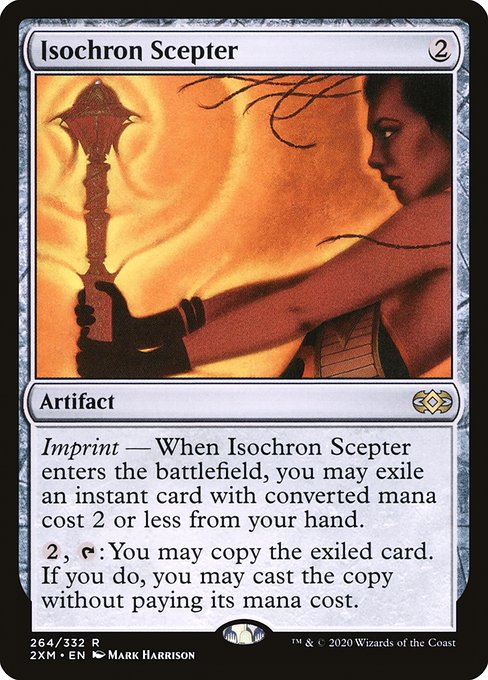 Isochron Scepter
Imprint — When this artifact enters, you may exile an instant card with mana value 2 or less from your hand.
Isochron Scepter
Imprint — When this artifact enters, you may exile an instant card with mana value 2 or less from your hand.
{2}, {T}: You may copy the exiled card. If you do, you may cast the copy without paying its mana cost.
. While you do take damage from it as well, that can easily be mitigated by building around it, which players typically do by running it in Mono-Red or two-color lists.
With so many eyes on the card right now, there’s even been some discussion around whether it’s too good for casual Commander or not in some circles. While this seems like a silly stance for the most part, given how tricky Burn is to make work overall, it’s a testament to the card’s power level that it’s even a talking point at all.
Despite how good it can be in Commander, Price of Progress isn’t quite the omnipresent staple you might expect. According to EDHREC data, around 58,500 decks run the card, which is decent but not as high as you’d expect from such a potent design.
Unfortunately, this relative lack of popularity doesn’t translate into a low price tag, as you’re still looking at around $8 for a non-List copy of this on the low end. That said, given how easily it can end games completely out of nowhere, this card is well worth taking for a spin in most red decks.
Stick with us here at mtgrocks.com: the best site for Magic: The Gathering coverage. Be sure to check out our deckbuilder for your next big brew, and our brand new MTG Rocks Podcast!