




Since its release in last year’s Final Fantasy, Starting Town has become a favorite among MTG players of all stripes. As an, often untapped, land that can tap for any color, it sees plenty of play in Standard, Commander, and even formats as far-flung as Legacy. In fact, it’s hard to find a format where this rainbow-hued beauty isn’t a staple in one deck or another.
While this is all well and good, the card isn’t perfect by any stretch. Nestled within its text box is a fairly egregious design misstep, and one which players are slowly starting to take notice of. Worryingly, it appears that design in this space is something that Wizards is leaning more into with each passing set, potentially to the detriment of the paper game a few years down the line.
MTG Players Raise Issues With Starting Town
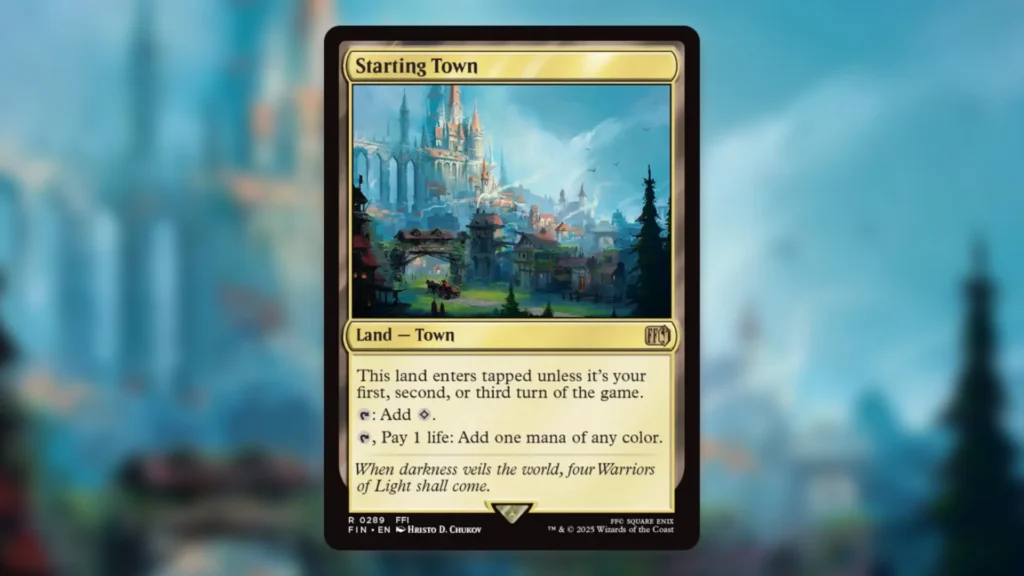
The issue with Starting Town as an MTG design is, chiefly, one of tracking. As pointed out by Chris Botelho on X, it’s “weird” that the land requires you to keep track of which turn of the game it is. While a handful of other cards, like Serra Avenger, do this, it’s a very rare design choice for a reason. Simply put, there’s no reliable in-game way to track the current turn number, at least not with the default setup.
The upshot of this is that Starting Town has a lot of potential to cause confusion and errors during games. As Robert Taylor noted in the comments, this actually happens fairly regularly even in competitive matches. Players drop Starting Town untapped after they’re supposed to, and it’s easy for opponents to miss the mistake and let it slide. With so much to keep track of already in Magic, turn count tends not to be on most players’ minds. This is bad enough as a potential innocent blunder, but the card is also ripe for abuse by cheaters and bad actors as well.
Perhaps the most frustrating aspect of Starting Town’s design, as mentioned by players like Connor Mackenzie, is that Wizards already solved the problem 16 years ago. The Fast Lands, which debuted in Scars of Mirrodin, worked almost identically by counting the number of lands you already had in play.
This was not only much easier to track, but it was also less punishing. With Starting Town, missing an early land drop is doubly devastating, since you have to deal with a tapped land on top of your mana problems. As Claudioh noted in the comments, this makes the card “miserable” to play with in many situations.
A Worrying Trend
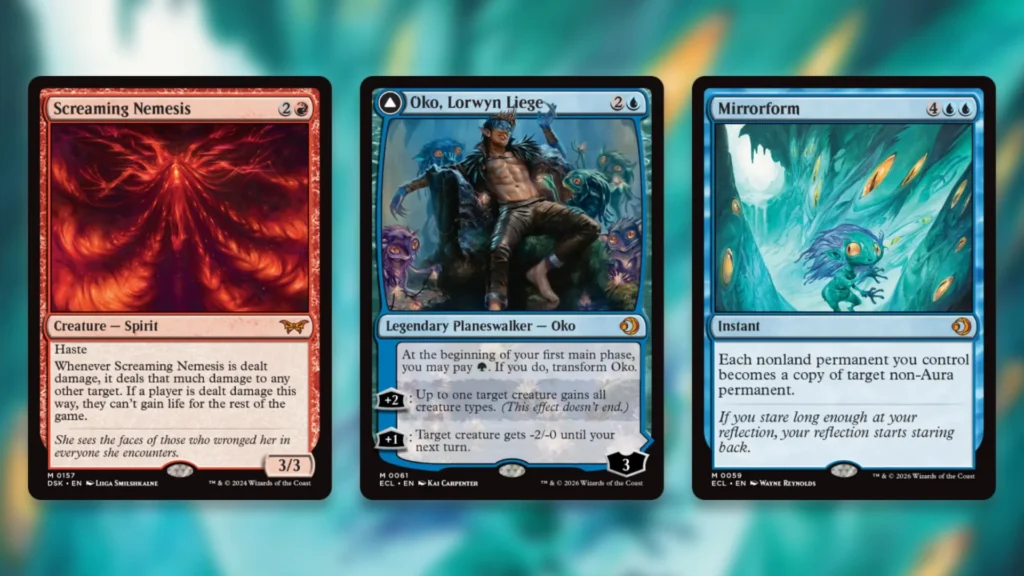
While Starting Town is by far the most prolific case, it’s not the only example of this school of MTG design in recent sets. In fact, looking at the past few years, and Lorwyn Eclipsed in particular, it seems that Wizards is leaning harder into effects with awkward tracking issues.
For the most part, these come in the form of cards that have a permanent impact on the game. Duskmourn’s Screaming Nemesis, for instance, turns off your opponent’s lifegain for the rest of the game. Since it doesn’t place a counter, however, you’re reliant on players remembering and keeping each other honest.
We’ve seen a few other one-off effects like this in sets recently, too, like Jace, Reawakened and Gornog, the Red Reaper. With Lorwyn Eclipsed, however, Wizards really pushed the boat out in this area. Between Oko, Lorwyn Liege, Mirrorform, Curious Colossus, and Abigale, Eloquent First-Year, there are four full cards in the set that cause permanent, untracked change. Each of these cards has the potential to cause similar issues to Starting Town, be it on the tournament tables or in Commander pods.
While nothing is certain for now, this trend suggests that Wizards is getting more comfortable pushing this kind of design. This is likely due, in part at least, to the continued success of MTG Arena. These kinds of tracking problems are a non-issue in digital, after all, where the client keeps everything straight for you. We’ve seen digital Magic impact on physical design in the past, even as recently as the Lorwyn Eclipsed Prerelease, and these new cards seem like yet another instance of this.
Temporary Fixes

While these tracking issues are frustrating, there are some ways you can get around them to an extent. In the same way that you carry tokens and counters that your deck needs, you can incorporate extra tracking aids if your deck runs one of these potentially problematic designs.
If you run Starting Town, for example, you can get in the habit of tracking the turn number on a die or piece of paper each game. You don’t need to do this all game, since only the first four turns are relevant, and doing so will ensure everyone knows where they stand when you drop it.
For the ‘permanent change’ cards we’ve seen recently, your best bet is likely to bring along a bunch of extra, color-coded counters. Placing green counters on creatures that Oko grants every creature type to, or gray counters on those that Abigale strips of abilities, is a nice way to handle these. It’s less ideal for Curious Colossus and Mirrorform, since they can potentially affect a lot of creatures, but it’s something.
Ideally, these measures will only be required temporarily. If Wizards continues to explore this design space, they’ll hopefully acknowledge the tracking issues, and work in a solution of their own. The above options aren’t infallible, and they don’t account for opponents playing the cards in their decks, either. If we don’t see some kind of solution emerge, then this school of design could mark the point where digital Magic encroaches too far on the physical game.
Stick with us here at mtgrocks.com: the best site for Magic: The Gathering coverage. Be sure to check out our deckbuilder for your next big brew!